AI Virtual Data Room: How AI VDR Tools Are Replacing Manual Due Diligence in 2026
AI Virtual Data Room: How AI VDR Tools Are Replacing Manual Due Diligence in 2026 There is a particular kind of exhaustion that sets in around day eighteen of a confirmatory diligence process. The buy-side accounting team has worked through the financial records. The legal team has reviewed the
AI Virtual Data Room: How AI VDR Tools Are Replacing Manual Due Diligence in 2026
There is a particular kind of exhaustion that sets in around day eighteen of a confirmatory diligence process. The buy-side accounting team has worked through the financial records.
The legal team has reviewed the material contracts. The operational team has submitted their third round of document requests.
And somewhere in the advisory firm's inbox, there are forty-seven unread messages from the buyer's associates, each containing follow-up questions that were supposed to go through the VDR's Q&A module but did not.
This is not a technology failure. It is a workflow failure — one that AI-assisted virtual data room tools are specifically designed to address.
The shift toward AI VDR platforms in the lower-middle market is not about replacing advisors. It is about eliminating the category of work that takes the most time and produces the least value: manually sorting documents, routing questions to the correct respondent, tracking which requests are outstanding, and reconciling whether the financial figures in the data room actually match the CIM.
These are tasks that consume advisory capacity without generating any insight that a qualified advisor needs to be the one producing.
Free Resource: Before opening your data room to any buyer group, run a complimentary due diligence evaluation report to surface document gaps, EBITDA discrepancies, and structural issues your team can close before the process goes live.
Why Manual VDR Review Has Become the Bottleneck in Modern M&A Processes
The mechanics of sell-side due diligence have not changed substantially in decades. A seller assembles documents.
A buyer reviews them. Questions are asked and answered.
Gaps are identified and addressed. The transaction closes or it does not.
What has changed is the volume and complexity of documentation that buyers now expect, the pace at which parallel workstreams run simultaneously, and the standard of financial and operational transparency that institutional buyers treat as table stakes before submitting a final offer.
In our experience working across lower-middle-market sell-side processes, the advisory team's time during active diligence is consumed by three activities that have almost nothing to do with strategic judgment: tracking document requests, routing questions to the right person, and reconciling inconsistencies between the marketing package and the data room documents. On a well-organized process, these activities might consume twenty to thirty percent of the advisory team's hours.
On a poorly organized one, they can consume the majority.
That time has a cost. When advisors are managing document logistics, they are not managing buyer relationships, monitoring competitive dynamics in the process, or preparing management for difficult conversations.
The administrative burden of a manual VDR workflow is not just inefficient — it reduces the quality of the strategic advisory work that actually drives outcomes.
AI VDR tools address this by automating the classification, routing, and tracking functions that consume advisor time, freeing the team to focus on the judgment-dependent work that cannot be systematized.
What "AI" Actually Does in a VDR Context
The term AI VDR is used broadly, and it is worth being precise about what it actually means in practice. Three distinct AI capabilities are relevant to VDR workflows in 2026:
Document classification and tagging — AI models trained on M&A document libraries can automatically identify document types, assign them to the correct folder category, and flag documents that appear to be in the wrong location or that are missing from expected categories. This eliminates the manual indexing work that typically takes junior team members several days at the beginning of a data room population process.
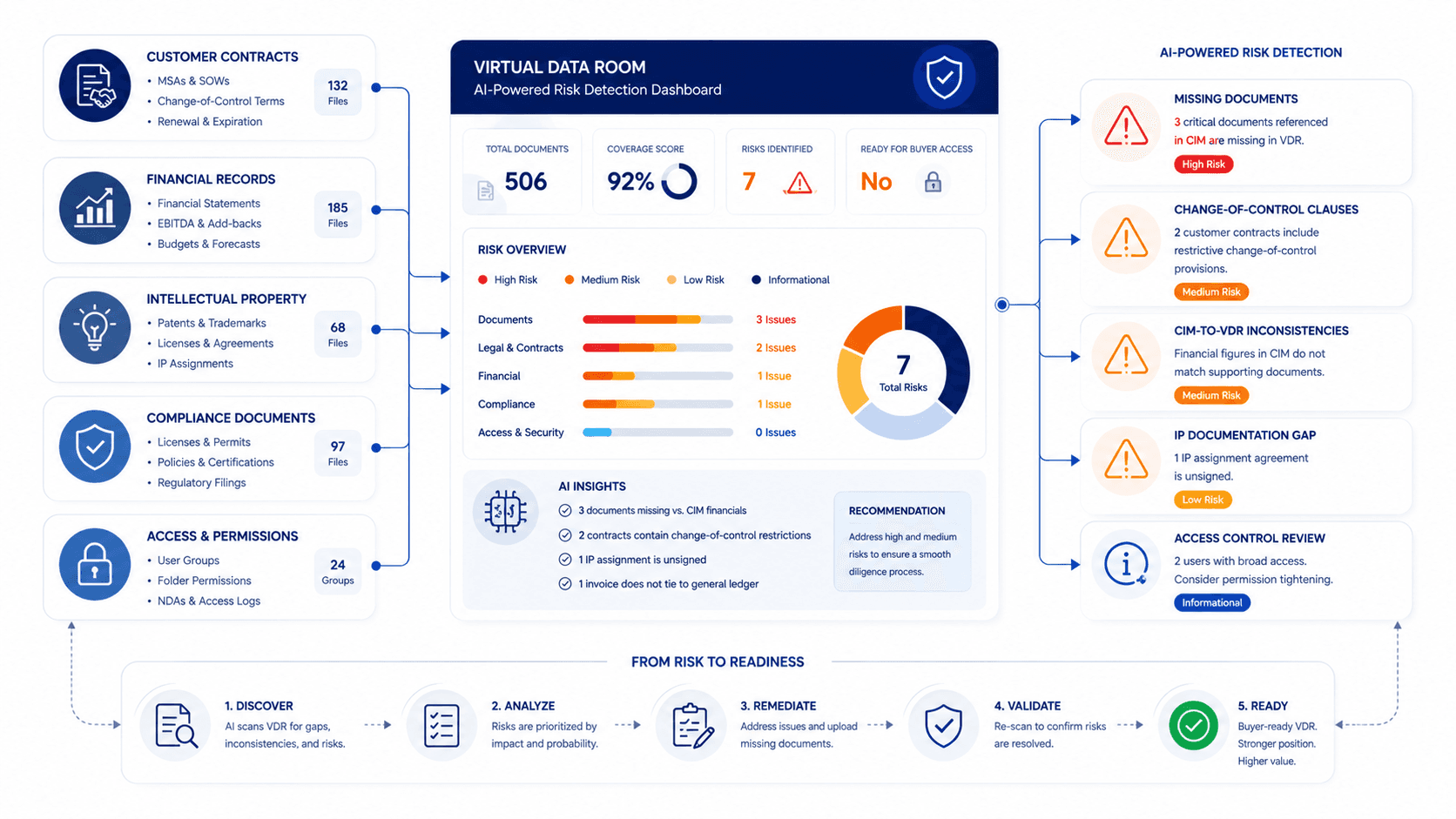
Risk signal detection — AI models can scan uploaded documents for language patterns associated with diligence risk: change-of-control clauses, automatic renewal provisions, exclusivity agreements, material adverse change definitions, and concentration-related terms in customer contracts. Rather than requiring legal review of every document before upload, the AI flags documents that warrant attorney attention.
Remediation task generation — Based on the gap analysis produced by document classification and risk scanning, AI systems can generate structured remediation task lists organized by diligence category, with severity ratings and suggested resolution approaches. This is the link between the diagnostic phase of a transaction and the VDR population phase.
What We Actually See In Deals: The manual process of identifying change-of-control clauses across a portfolio of twenty to forty material customer contracts typically requires several hours of paralegal or junior associate time per engagement. AI-assisted contract scanning completes the same review in minutes and produces a higher-confidence output because the model does not get tired or miss a clause on page eight of a forty-page agreement. We have seen this single capability prevent multiple late-stage diligence surprises.
Case Studies: Manual Review vs AI-Assisted VDR in Live Transactions
Case Study: The Boutique Firm That Spent Three Weeks on Document Sorting
An advisory team we are familiar with ran a sell-side process for a Mid-Atlantic professional services company using a traditional VDR platform with no AI-assisted features. The document collection phase was handled manually: the client emailed files to a junior associate, who downloaded, renamed, and uploaded each document according to a folder taxonomy that had been built in a spreadsheet.
Three weeks into the process, after the VDR had launched to the first buyer group, the buyer's legal team submitted a document request for all agreements with change-of-control provisions. The advisory team had not conducted a systematic review for these clauses during the population phase.
Two attorneys then spent the better part of a week manually reviewing fifty-one uploaded agreements to produce the response.
One agreement — a facilities management contract covering the company's primary office — contained a consent requirement that had been missed. Addressing it after the buyer had already flagged it placed the seller in a reactive position: the buyer requested a closing condition tied to receipt of landlord consent, adding a contingency to a transaction that had been running cleanly to that point.
The issue was ultimately resolved. But the sequence — missed clause, buyer discovery, reactive cure — was entirely avoidable.
How It Should Be Done: AI Risk Scanning Before the First Buyer Logs In
A contrasting situation involved an advisory firm that integrated AI-assisted contract scanning into its VDR preparation workflow before launching a process for a Southeast technology company.
During the pre-launch document population phase, the AI system flagged nine agreements as containing assignment restriction language that warranted legal review. The advisory team's outside counsel reviewed the nine flagged documents over two days, confirmed that two required affirmative consent before the transaction could close, and initiated the consent process with those counterparties proactively — before any buyer had been invited into the data room.
By the time confirmatory diligence began, both consent letters had been obtained and were available in the VDR as supporting documentation. When the buyer's legal team reviewed material contracts, they found the consent letters already in place.
Rather than triggering a closing condition request, the pre-obtained consents were cited by the buyer's counsel as evidence that the seller's legal team had run a well-organized process.
The transaction closed with no consent-related contingencies. The two days of AI-assisted pre-screening had eliminated weeks of potential reactive remediation.
How AI VDR Tools Work: A 4-Step Process Breakdown
Step 1: Automated Document Classification and Taxonomy Assignment
When documents are uploaded to an AI-enabled VDR platform, the classification engine processes each file and assigns it to the appropriate folder category based on document type recognition, key term identification, and comparison against a reference taxonomy trained on M&A document libraries.
For advisory teams building a VDR from scratch, this eliminates the manual indexing phase entirely. For teams migrating documents from an existing client file system — where documents may have been stored in idiosyncratic folder structures with inconsistent naming conventions — AI classification identifies where each document should live in the standard taxonomy and flags any documents that do not fit cleanly into established categories, which are often the most important ones to review.
The output is a structured, consistently organized document set that reflects standard buy-side diligence expectations before any buyer has logged in.
Step 2: Risk Signal Detection and Priority Flagging
Once documents are classified, the AI scanning layer reviews each document for language patterns associated with diligence risk. The categories of risk signals relevant to lower-middle-market M&A include:
- Assignment and change-of-control restrictions in customer, vendor, and financing agreements
- Automatic renewal clauses that may create post-closing obligations not reflected in working capital analysis
- Exclusivity provisions that limit the company's ability to engage with competing buyers
- Revenue recognition terms in customer agreements that may conflict with the company's reported accounting treatment
- Employment agreement provisions — non-competes, severance triggers, change-of-control bonuses — that affect the cost structure the buyer is acquiring
Each flagged document is returned with a risk category, a severity indicator, and the specific language passage that triggered the flag. The advisory team's legal counsel then reviews flagged items in priority order, rather than reviewing every document regardless of risk level.
Step 3: Gap Analysis and Remediation Task Generation
After the initial document population and risk scanning are complete, the AI system compares the document set against a reference framework of expected diligence materials by category. Missing documents are identified, categorized by diligence phase, and presented as a structured gap list.
This gap list forms the basis for the pre-launch remediation phase — the eight to twelve weeks during which the advisory team and client work to close document gaps before any buyer has access. Each item on the list becomes an assigned task: collect this document, execute this agreement, obtain this certificate, file this amended return.
Without AI-assisted gap analysis, this process relies on the advisor's experience and memory. It is effective in the hands of a senior advisor with deep diligence experience, but it is inconsistent across team members and engagement types.
AI-assisted gap analysis produces the same thoroughness regardless of who is running the process.
Step 4: Q&A Routing and Real-Time Diligence Tracking
During the live buyer access phase, AI-assisted VDR platforms route incoming Q&A submissions to the appropriate advisor based on question category and content. Financial questions go to the financial advisor.
Legal questions go to outside counsel. Operational questions go to management.
Questions that span categories are flagged for advisory team triage.
The platform maintains a real-time status dashboard showing which document requests are outstanding, which have been responded to, which buyer groups have reviewed which sections of the VDR, and which documents have been viewed most frequently — often a leading indicator of where buyer concerns are concentrated.
Traditional VDR vs AI VDR: A Side-by-Side Comparison
Traditional VDR (Manual Workflow)
- Document classification: Manual — junior associate or paralegal indexes each document by hand
- Change-of-control review: Requires attorney review of every material agreement; time-intensive
- Gap identification: Relies on advisor experience and engagement-specific checklists; inconsistent
- Q&A routing: Manual — advisor reads each question and forwards to appropriate respondent
- Diligence tracking: Spreadsheet-based; requires manual updates; prone to version conflicts
- Risk signal detection: Reactive — issues identified when buyers flag them during active diligence
- Pre-launch preparation time: Typically 8-16 weeks depending on document volume and complexity
- Buyer experience: Varies significantly based on advisor team's organizational discipline
AI-Assisted VDR (Automated Workflow)
- Document classification: Automated — AI assigns documents to correct folder categories on upload
- Change-of-control review: AI scans all documents and flags risk language for attorney review within hours
- Gap identification: Systematic — AI compares document set against reference framework for each category
- Q&A routing: Automated — AI categorizes questions and routes to correct respondent by content type
- Diligence tracking: Real-time dashboard; no manual updates required
- Risk signal detection: Proactive — issues flagged during pre-launch preparation before buyer access
- Pre-launch preparation time: Compression of classification and scanning phases; advisor time focused on judgment-dependent work
- Buyer experience: Consistently organized, responsive, gap-free from day one of access
How AIVI's AI-Powered Workflow Handles VDR Remediation
The AIVI platform integrates the AI-assisted gap analysis, remediation task management, and document preparation functions described above into a single advisory workflow — one that begins with the client's exit readiness diagnostic and runs through the VDR launch and active diligence phases.
When a client completes the 40-point exit readiness assessment, the platform's AI layer cross-references the diagnostic responses against a master diligence framework, generating a structured gap list organized by category and priority. Each gap feeds directly into the AI-powered VDR remediation workflow: an advisor-managed Kanban board where each document gap or remediation task is tracked from identification through completion, with separate visibility for the advisory team and the client.
The automated CIM drafting function ensures that the financial figures and operational claims in the marketing package originate from the same diagnostic data that drives the VDR preparation checklist. This integration eliminates the most common source of CIM-to-VDR discrepancy — two separate teams working from two separate data sources — before the first buyer conversation takes place.
For advisors managing multiple simultaneous engagements, the platform's workflow architecture allows consistent VDR preparation standards across all clients regardless of which team member is leading each process. The AI-assisted classification and risk scanning functions produce the same thoroughness on every engagement.
The VDR due diligence checklist integration ensures no document category is overlooked.
Frequently Asked Questions
What is an AI VDR?
An AI virtual data room is a purpose-built M&A document platform that integrates artificial intelligence capabilities — including document classification, risk signal detection, gap analysis, and Q&A routing — into the standard VDR workflow. Unlike traditional VDR platforms that serve primarily as secure document repositories, AI VDR tools automate the administrative and analytical functions that typically consume significant advisor and legal team time during the diligence preparation and active buyer access phases of a transaction.
Can AI replace legal review of due diligence documents?
No. AI-assisted document scanning identifies language patterns associated with risk — change-of-control clauses, assignment restrictions, automatic renewal provisions — and flags these passages for attorney review.
It does not interpret the legal implications of those clauses, assess their negotiating significance in the context of the specific transaction, or draft the contractual provisions needed to address them. AI reduces the time required to identify which documents need legal attention; it does not eliminate the need for qualified legal review of those documents.
How accurate is AI contract scanning for change-of-control clause detection?
AI contract scanning tools trained on M&A document libraries perform well on standard commercial agreements — MSAs, vendor contracts, lease agreements — where change-of-control language follows predictable patterns. Performance is generally lower on highly customized enterprise agreements, government contracts, or documents written under legal frameworks from outside the US.
For high-stakes transactions, AI scanning should be treated as a first-pass triage tool that directs attorney review, not as a substitute for it.
Does using an AI VDR change how buyers experience the diligence process?
From the buyer's perspective, an AI VDR process typically produces a more organized and responsive data room experience: documents are consistently categorized, Q&A responses are faster and more consistently routed, and gap requests are less frequent because pre-launch preparation has been more thorough. Sophisticated institutional buyers — particularly PE firms that run many simultaneous diligence processes — recognize these signals and often interpret a well-organized, AI-assisted VDR as evidence of an advisors team with strong process discipline.
What types of transactions benefit most from AI VDR tools?
AI VDR tools produce the greatest efficiency gains in transactions with high document volumes — typically businesses with complex customer contract portfolios, multi-entity corporate structures, or extensive regulatory compliance records. For very small transactions with simple document sets, the automation benefit is less pronounced.
The risk signal detection function — specifically change-of-control clause scanning — provides value across essentially all transaction sizes, since even simple businesses frequently have assignment restriction language in their core commercial agreements that is not reviewed until buyer diligence is underway.
Disclaimer: The financial and legal information provided in this article does not, and is not intended to, constitute professional legal or financial advice; instead, all information, content, and materials available on this site are for general informational purposes only. Readers should contact their legal counsel or certified public accountant to obtain advice with respect to any particular transaction or regulatory matter.
Ready to automate M&A drafting & secure transaction readiness?
AIVI empowers boutique M&A firms and investment banks to generate CIMs, conduct instant VDR gap checks, and manage exit readiness automatically from a unified data model.