Best Ansarada Alternatives for Boutique M&A Advisors (2026)
Best Ansarada Alternatives for Boutique M&A Advisors (2026) It usually starts during a live deal. A seller-side advisor logs into the platform at 11 p.m. to check buyer activity — and discovers the analytics dashboard has changed layout again, the file they uploaded three hours ago is still proc
Quick answer
What is the best alternative to Ansarada VDR?
For boutique advisors, modern platforms like DealRoom and AIVI are the best alternatives, offering transparent flat-rate pricing, intuitive interfaces, and AI-powered document review tools.
Topics covered
- Why Advisors are Switching from Ansarada in 2026
- Top 5 Ansarada Alternatives Compared
- Pricing Comparison: Transparent vs. Overage Models
- AIVI: The AI-Powered Alternative for Small Deal Teams
Why do sellers switch away from Ansarada?
Advisors cite outdated user interfaces, high costs, complex buyer onboarding, and lack of genuine AI automation as the top reasons for choosing alternatives.
Are there free virtual data rooms available?
While basic cloud storage like Google Drive is free, they lack the security and compliance requirements for M&A transactions. AIVI offers budget-friendly VDR workflows starting at $199/month.
Best Ansarada Alternatives for Boutique M&A Advisors (2026)
It usually starts during a live deal. A seller-side advisor logs into the platform at 11 p.m. to check buyer activity — and discovers the analytics dashboard has changed layout again, the file they uploaded three hours ago is still processing, and the client portal looks nothing like what they showed the seller during onboarding. The subscription renewal notice sitting in their inbox quotes a price that would make a mid-market CFO wince. The question surfaces, quietly at first: is there a better way to do this?
For boutique M&A advisors, that question has become much harder to ignore. Ansarada has long positioned itself as the default choice for mid-market virtual data rooms, and for a stretch of time, that position made sense. But 2026 looks different. The gap between what legacy platforms deliver and what modern sell-side workflows actually require has widened — and a new cohort of tools is filling it.
Free Resource: Before you switch anything, use our Exit Readiness Scorecard to benchmark your current deal preparation process. It takes eight minutes and gives you a baseline score you can track over time.
Why Ansarada's Limitations Are Now a Competitive Problem
The SEC's Regulation S-K disclosure requirements haven't gotten simpler, and buyer due diligence request lists have expanded significantly as private equity firms run tighter pre-LOI screens. Advisors managing lower-middle-market sell-side engagements — businesses in the $5M–$40M revenue range — are now routinely assembling VDRs with 200 to 300 document line items before the first buyer call.
To justify these complex structures and ensure the baseline financials are flawless, deal teams can calculate target discount rates and capital structure benchmarks using our free WACC calculator before opening the room to buyers.
That volume demands a platform that is fast to set up, easy to navigate, and honest about its costs. On all three counts, G2 reviews from 2025 and 2026 paint a consistent picture of Ansarada's shortcomings.
The most cited issues, pulled directly from verified user reviews on G2.com, cluster around three themes:
The interface is stuck in a previous decade. Multiple reviewers describe it as feeling like "early 2000s software." Navigation requires more clicks than it should. File previews often force downloads. New users — including the clients and buyers that advisors need to onboard quickly — find the learning curve steep.
The pricing model is punishing at the margins. Storage caps with overage fees catch firms off guard mid-deal. There are no flexible options for boutique shops running one or two transactions at a time without committing to enterprise-scale contracts.
The AI features don't deliver. Ansarada's "Aida" AI assistant has received repeated criticism for being unreliable. Advisors who need genuine AI output — document classification, risk flagging, CIM drafting — report that the platform's AI is largely cosmetic.
This is where the alternative conversation starts.
Case Studies: The Difference a Platform Switch Makes
Case Study: Staying Put Has Compounding Costs
A mid-Atlantic advisory firm running four concurrent sell-side processes stayed on a legacy VDR platform because switching mid-deal felt too risky. The platform worked — at a basic level. Files were uploaded, buyers had access, permissions were managed. But the advisor team spent roughly three to four hours per deal manually reorganizing folder structures after clients uploaded documents in the wrong locations, because the interface gave clients no intuitive guidance about where things belonged.
Over the course of a year, the administrative overhead was meaningful. More frustrating: two buyers cited VDR disorganization as a reason for slower confirmatory diligence. One deal extended by several weeks for reasons that had nothing to do with the business itself.
Most advisors never directly attribute those delays to the software. That's the problem — the cost is invisible until you look for it.
How It Should Be Done: What a Clean Transition Looks Like
A Southeast-based boutique switched platforms between deals, not during one. They spent two weeks migrating their standard folder template, their checklist workflow, and their client onboarding materials. The first deal they ran on the new platform took about half the setup time they expected. Buyers commented on how clean the structure was. The advisor team stopped fielding calls from clients asking where to upload things.
That's not a dramatic transformation story. That's just what happens when the tool fits the work.
How to Evaluate an Ansarada Alternative: A Practical Checklist
Not every platform that markets itself as a "modern VDR" deserves the label. Here is how to cut through the noise.
Phase 1: Define Your Actual Workflow Requirements
- Map your typical deal cycle. How many documents? How many buyer groups? Do you need granular permission controls or is a simpler structure fine for your deal size?
- Identify your client profile. Are your sellers tech-comfortable or will they need a very simple upload experience? A platform that works for a SaaS founder may frustrate a third-generation manufacturer.
- Clarify your AI needs. Do you need genuine AI features (document classification, CIM drafting, risk scoring) or is a clean file repository sufficient?
⚠️ Common Mistake: Evaluating a platform based on its feature list rather than its actual day-one workflow. A platform with 40 features that takes 90 minutes to set up is worse than a platform with 15 features that takes 10.
Phase 2: Pressure-Test the Pricing Model
- Ask for the full cost at your actual volume. Get a clear answer on storage limits, per-deal fees, overage charges, and annual vs. monthly flexibility.
- Run the math on your slowest month. If you have a quiet quarter, are you still locked into a rate that was designed for a firm running 20 deals a year?
- Verify cancellation terms. Enterprise contracts with 12-month minimums are standard at the legacy tier. If you are a boutique running three to five deals annually, monthly flexibility is not a luxury — it is a cash flow protection measure.
⚠️ Common Mistake: Accepting the first quote. Legacy platforms often have significant flexibility they don't advertise. That said, if negotiating pricing requires a three-call process with a sales team, that is already telling you something about how the vendor relationship will work.
Phase 3: Test the User Experience Before You Commit
- Run a real file upload — not a demo. Take 50 files from an old deal and upload them. See how the folder structure behaves, how long processing takes, and whether the index updates correctly.
- Invite a test buyer. Send a colleague a guest link and ask them to find three specific documents without guidance. Time it. This is the closest simulation of your actual buyer experience.
- Try the client upload flow. Ask your assistant or a client who is not a tech power user to upload a folder of files. Watch where they get confused.
Phase 4: Evaluate AI Features Honestly
- Ask for a live demo of AI output. Not a slide deck — actual AI-generated content from your deal type. If the demo uses generic sample data that looks nothing like lower-middle-market sell-side materials, ask why.
- Test document classification. Upload a folder of mixed document types and see if the AI correctly categorizes them. This is a basic capability; if it fails here, the more sophisticated features will also underperform.
Legacy Platforms vs. Modern Alternatives: What Changes
Legacy VDR Approach (Ansarada, Datasite, Intralinks)
- Setup time: Two to four hours per deal with manual folder structuring
- Pricing model: Storage-capped, overage penalties, enterprise contracts
- AI features: Limited or unreliable, despite marketing claims
- Client experience: Steep learning curve, frequent advisor hand-holding required
- Support model: Enterprise CSM model works for bulge-bracket firms; slow response for boutiques
Modern Platform Approach (AIVI and comparable tools)
- Setup time: Under 30 minutes with templated workflows
- Pricing model: Flat monthly or per-deal pricing, no storage overages
- AI features: Functional AI output — document risk scoring, CIM generation, EBITDA normalization
- Client experience: Intuitive interfaces designed for non-technical sellers
- Support model: Self-serve documentation with responsive support tiers
How AIVI Fills the Ansarada Gap for Boutique Advisors
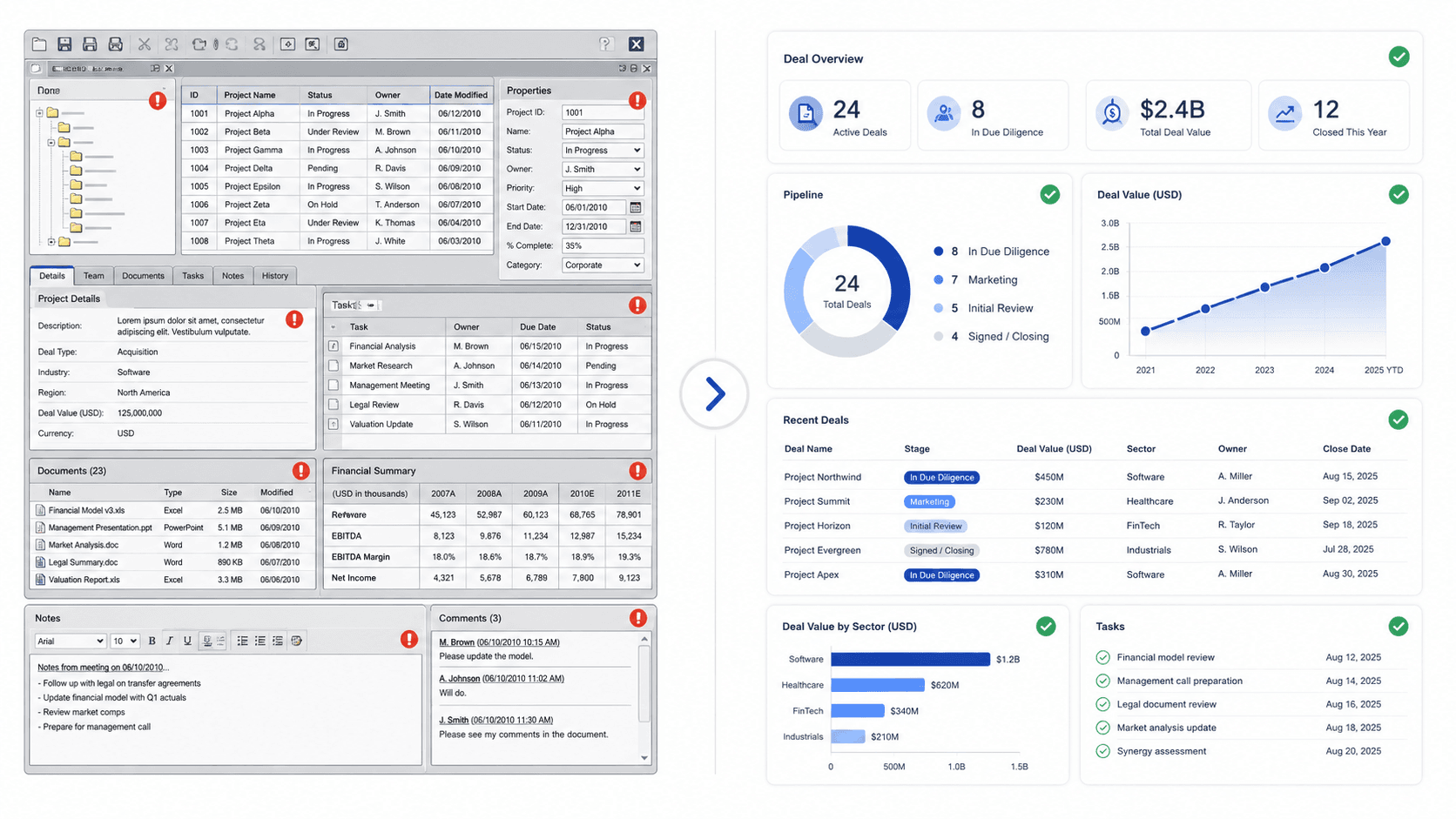
Advisory teams using AIVI's VDR remediation Kanban report a meaningfully different setup experience. The Kanban board maps directly to a standard due diligence request list — advisors import their checklist, assign items to the client, and track completion without leaving the platform. Buyers see a clean, organized repository. The advisor sees a real-time status board.
On the document preparation side, automated CIM drafting generates a structured first draft from the assessment data already collected during the exit readiness process. That draft is not a finished document — it is a starting point that eliminates the first two or three hours of blank-page writing that advisors typically absorb.
AIVI's transparent flat-rate pricing starts at $199/month with no storage penalties and no enterprise contract requirements. Boutique firms running two to four deals annually can size their plan to their actual volume.
Frequently Asked Questions
What is the best Ansarada alternative for small investment banks in 2026?
The right answer depends on deal volume and workflow complexity. For boutique advisory firms running three to ten sell-side transactions annually, the strongest alternatives combine genuine AI features with flat-rate pricing and a setup process that doesn't require a dedicated CSM. Platforms like AI Valuation Insight are built specifically for this segment. Larger alternatives like Datasite and Intralinks are more appropriate for bulge-bracket or large-cap deal teams that need the institutional credibility those brands carry.
How much does Ansarada cost compared to alternatives?
Ansarada's pricing is not publicly disclosed and is typically negotiated on a per-deal or annual subscription basis. Users on G2.com frequently cite unexpected costs from storage overages and premium feature add-ons. Modern alternatives targeting boutique advisors typically offer flat monthly pricing in the $200–$1,200 range depending on deal volume and feature access, with no storage penalties.
Can I switch VDR platforms mid-deal?
It is technically possible but generally inadvisable. The practical disruption — re-permissioning buyer groups, migrating folder structures, re-sending access links — creates enough friction that most advisors wait until between deals. The better approach is to evaluate and switch during a quiet period, then build a standardized template so the next deal setup is significantly faster.
Does Ansarada have real AI features?
Ansarada markets an AI assistant called Aida. Multiple G2 reviewers from 2025 and 2026 describe it as unreliable and disconnected from the current generation of AI tools. The consensus is that the platform's AI features do not deliver meaningful productivity gains for the typical sell-side workflow. This is in contrast to platforms that offer document classification, CIM generation, and risk scoring as core outputs.
What should boutique M&A advisors look for in a VDR alternative?
The five most important criteria are: (1) flat-rate or per-deal pricing without storage overages, (2) a setup time under 30 minutes per deal, (3) a client upload experience simple enough for non-technical sellers, (4) genuine AI features rather than marketing labels, and (5) granular but intuitive permission controls for managing multiple buyer groups simultaneously. The FTC's HSR premerger notification guidelines are a useful reference for understanding what level of document organization buyers and regulators actually expect at each deal stage.
Disclaimer: The financial and legal information provided in this article does not, and is not intended to, constitute professional legal or financial advice; instead, all information, content, and materials available on this site are for general informational purposes only. Readers should contact their legal counsel or certified public accountant to obtain advice with respect to any particular transaction or regulatory matter.
Ready to automate M&A drafting & secure transaction readiness?
AIVI empowers boutique M&A firms and investment banks to generate CIMs, conduct instant VDR gap checks, and manage exit readiness automatically from a unified data model.