CIM Automation Software: How AI Is Replacing Manual CIM Writing for Boutique Advisors in 2026
CIM Automation Software: How AI Is Replacing Manual CIM Writing for Boutique Advisors in 2026 There is a peculiar inefficiency built into the standard boutique M&A advisory workflow that most advisors have simply accepted as the cost of doing business: the Confidential Information Memorandum tak
Quick answer
What is CIM automation software?
CIM automation software helps M&A advisors turn company data, financials, and buyer positioning into a first-draft confidential information memorandum.
Topics covered
- AI CIM Software vs. Manual Pitch Books
- Best Use Cases for Boutique Advisors
- CIM Automation Workflow
- Risks and Human Review Requirements
Can AI write a final CIM by itself?
No. AI can create a strong first draft, but an advisor still needs to verify financials, buyer positioning, risk disclosure, and deal-specific narrative.
Who benefits most from CIM automation?
Boutique advisors benefit most because they need investment-bank-quality materials without a large analyst team on every lower-middle-market deal.
CIM Automation Software: How AI Is Replacing Manual CIM Writing for Boutique Advisors in 2026
There is a peculiar inefficiency built into the standard boutique M&A advisory workflow that most advisors have simply accepted as the cost of doing business: the Confidential Information Memorandum takes weeks to write, requires significant senior advisor involvement to get right, and then needs to be substantially rewritten every time the client updates their financial projections or changes their story about why now is the right time to sell.
For a firm managing two or three simultaneous sell-side engagements, the cumulative CIM drafting burden can consume a material portion of the senior team's available hours — hours that would be more productively spent managing buyer relationships, advising on deal structure, or developing new client relationships.
The alternative, delegating CIM writing to junior staff without strong M&A narrative experience, produces first drafts that read like financial summaries rather than buyer-facing investment stories. The round-trip of edits, rewrites, and review cycles between junior writer and senior editor often takes longer than the senior advisor simply drafting the document themselves.
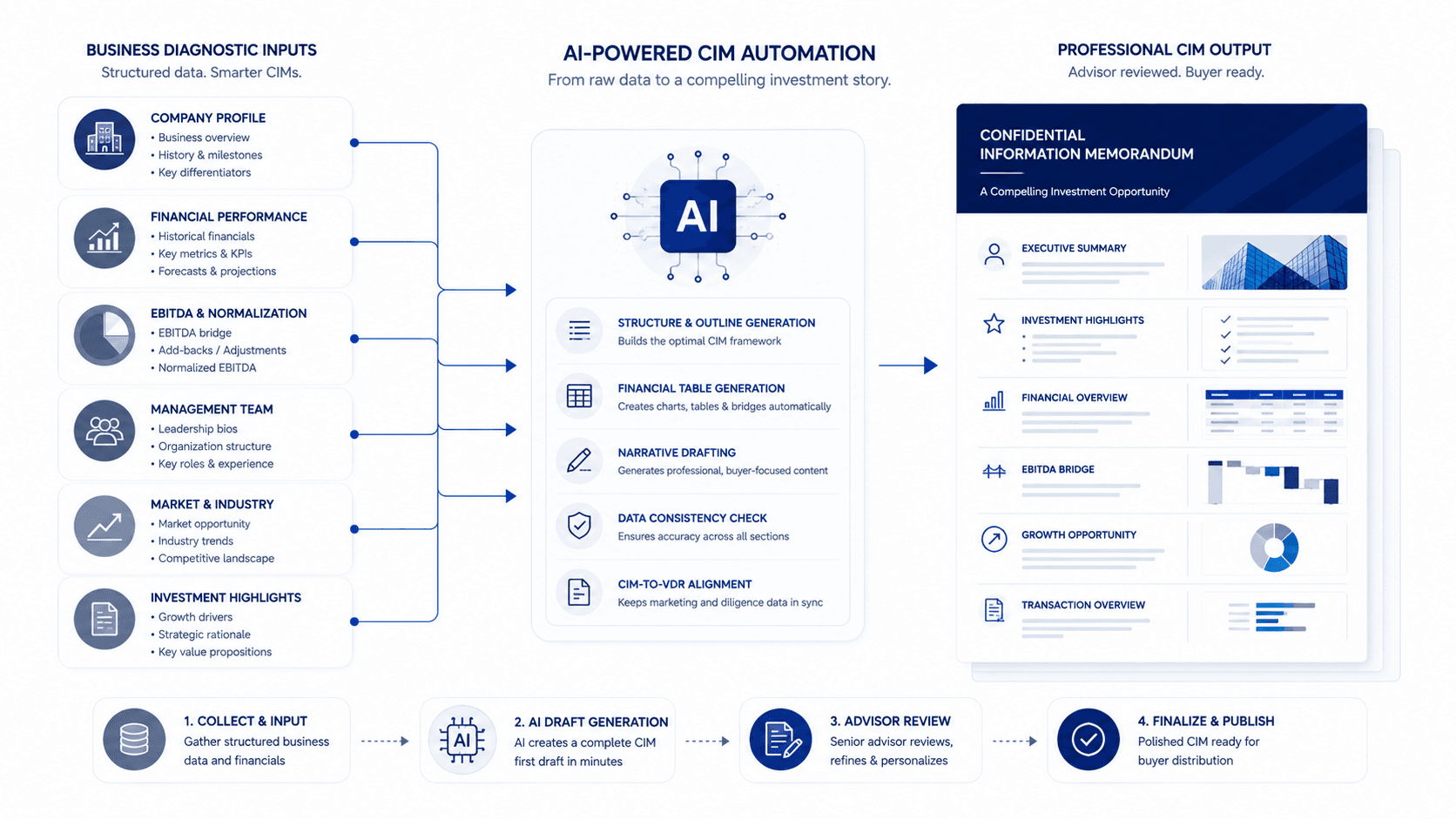
CIM automation software addresses this by generating a structured first draft from a standardized data input — the client's diagnostic responses, financial figures, and operational profile — that a senior advisor can then review, refine, and personalize in a fraction of the time a from-scratch draft would require.
Free Resource: See how Auto-CIM Generator converts exit readiness diagnostic data into a structured CIM first draft — and get a complimentary due diligence evaluation report to identify the financial gaps that most commonly create CIM-to-VDR discrepancies.
Why Manual CIM Writing Is the Biggest Time Cost in Boutique Advisory
The CIM is the foundational marketing document of any sell-side M&A process. It introduces the business to prospective buyers, presents the investment thesis, summarizes the financial profile, and establishes the narrative around growth potential and deal rationale.
A well-written CIM generates serious buyer interest and sets the pricing expectations that the process will either confirm or disappoint.
Writing it well takes time. In our experience working with boutique advisory firms, the manual CIM drafting process typically follows this sequence: an advisor conducts an intake session with the client to gather business information, a junior team member organizes the raw material into a document structure, a senior advisor rewrites the narrative sections to make them buyer-facing and compelling, the client reviews and requests changes (often substantial ones), and the cycle repeats one to three more times before the document is ready for distribution.
From first meeting to finalized CIM, this process commonly runs four to eight weeks in practice. On a typical boutique advisory engagement, the CIM is the first major deliverable — and it blocks the marketing phase from beginning until it is complete.
That delay has a real cost. Every week the marketing phase is delayed is a week the seller is operating a business they have mentally committed to selling, a week the advisory team's time is consumed by document production rather than buyer relationship development, and a week the deal's momentum — which is highest immediately after engagement launch — is not being used.
What CIM Automation Software Actually Does
CIM automation tools do not generate finished CIMs ready for buyer distribution. That framing sets unrealistic expectations and misses the actual value proposition. What automation does well is:
Structural first-draft generation — Given a standardized set of inputs (business description, financial figures, operational profile, management team, growth drivers), an AI-assisted CIM tool generates a complete document structure with all standard sections populated with the relevant data, formatted consistently, and written in a buyer-facing tone that reflects M&A advisory language norms.
Financial table automation — Revenue summaries, EBITDA bridges, historical financial comparison tables, and projection sensitivity analyses are generated automatically from the financial data inputs, eliminating the manual formatting work that consumes junior associate time.
Narrative consistency enforcement — Automation ensures that the financial figures referenced in the narrative sections match the financial tables, the management team descriptions match the organizational chart, and the investment thesis is consistent across all document sections. This catches the kind of internal inconsistency that is easy to introduce in a manually assembled multi-section document.
The output is a structured first draft that typically requires one to two rounds of senior advisor review and refinement — rather than three to five rounds — to reach distribution-ready quality.
What We Actually See In Deals: The most common source of CIM-to-VDR discrepancy — the situation where the financial figures in the marketing document do not match the supporting records in the data room — is not deliberate misrepresentation. It is the natural result of a CIM being drafted from one data source and a VDR being populated from another, with different people responsible for each. When CIM automation is integrated with the VDR preparation workflow, both documents originate from the same data — and the discrepancy problem is solved at the source.
Case Studies: Manual CIM Process vs Automated CIM Workflow
Case Study: The Eight-Week CIM That Undermined Process Momentum
A boutique advisory firm we are familiar with launched a sell-side engagement for a business services company with a target process start date six weeks after engagement kick-off. The timeline was aggressive but achievable — if the CIM was completed on schedule.
It was not. The client's financial data was more complex than initially apparent: the business had a holding company structure with multiple operating entities, intercompany transactions that needed to be eliminated in the consolidated financials, and an EBITDA normalization narrative that required careful framing to be credible to institutional buyers.
The first draft, produced by a junior associate over two weeks, reflected the financial complexity but missed the investment narrative entirely — it read like an accounting memo rather than a buyer-facing investment story. Two full senior advisor rewrites and three client review cycles later, the CIM was finalized eight weeks after engagement launch.
By the time the marketing phase began, the initial energy from the engagement launch had dissipated. Key buyer contacts who had been briefed at engagement start had moved on to other opportunities they were actively evaluating.
The process launched into a quieter buyer universe than the one that had existed eight weeks earlier.
The firm's senior advisor acknowledged afterward that the CIM drafting process was their primary bottleneck and that they had no systematic way to compress it.
How It Should Be Done: First Draft in Days, Not Weeks
An advisory firm that implemented CIM automation as part of their engagement workflow described a markedly different experience. When a client completes the standardized exit readiness diagnostic, the automation platform generates a first-draft CIM within hours — a complete document with all standard sections populated, financial tables formatted, and the EBITDA normalization bridge pre-constructed from the diagnostic inputs.
The senior advisor's first review session — which typically runs two to three hours — focuses on narrative refinement, industry-specific positioning, and any adjustments to the investment thesis. By the end of that session, the document is at roughly seventy to eighty percent of distribution quality.
One client review cycle and a final advisor polish session produce the finalized document.
Total elapsed time from engagement kickoff to finalized CIM: ten to fourteen days. The firm described the reduction in drafting time as the most significant workflow improvement they had implemented in years — not because the automation produced a perfect document, but because it eliminated the structural scaffolding work that had previously consumed most of the senior team's drafting time.
How CIM Automation Software Works: A Step-by-Step Breakdown
Step 1: Standardized Data Input via Exit Readiness Diagnostic
The quality of an automated CIM draft is entirely dependent on the quality and completeness of the input data. Well-designed CIM automation tools capture data through a structured diagnostic process — a guided assessment that walks the client through their business profile, financial history, operational structure, management team, customer relationships, and growth drivers in a format specifically designed to populate a CIM-ready data model.
This is meaningfully different from asking the client to fill out a template. A diagnostic-based input captures not just data points but the narrative context around them: not just "we have fifteen enterprise customers" but "our top customer has been with us for eight years, auto-renews annually, and represents approximately twenty percent of revenue." The latter is CIM content.
The former is a data point.
Step 2: Automated First-Draft Generation
With the diagnostic complete, the automation engine generates a structured first-draft CIM. Standard sections include executive summary, company overview, products and services, market and competitive landscape, financial overview, management team, and the investment thesis.
Financial tables — trailing twelve months revenue, three-year EBITDA summary, revenue bridge, normalization add-back schedule — are auto-populated from the financial data inputs.
The generated draft reflects M&A advisory language norms rather than generic business writing. The investment thesis is framed around buyer value drivers rather than seller pride of ownership.
The financial narrative focuses on what the numbers mean for a buyer's underwriting rather than what they mean operationally.
Step 3: Senior Advisor Review and Narrative Refinement
The automation-generated draft is the starting point, not the endpoint. A senior advisor reviews each section for accuracy, competitive positioning, and the kind of industry-specific nuance that reflects genuine advisory expertise.
This review is fundamentally different from the review of a junior associate's first draft. The advisor is refining a document that is already structurally complete and substantively accurate, rather than correcting a document that requires fundamental rewriting.
The cognitive load of the review session is lower, the iteration cycle is faster, and the senior advisor's time is focused on the highest-value contribution: the narrative judgment that automation cannot replicate.
Step 4: Consistency Verification with VDR Document Set
Before the CIM is distributed to buyers, the financial figures in the document must be reconciled against the financial records that will appear in the data room. This is the CIM-to-VDR consistency check — and it is the step most frequently skipped in manual workflows.
CIM automation tools that are integrated with the VDR preparation workflow perform this reconciliation automatically: the normalized EBITDA in the CIM is generated from the same data model as the EBITDA bridge support documents in the VDR. There is no opportunity for the kind of data-entry error or version mismatch that creates buyer-facing discrepancies during confirmatory diligence.
Manual CIM Writing vs CIM Automation Software: A Direct Comparison
Manual CIM Writing
- First draft timeline: 2-4 weeks from engagement kick-off
- Senior advisor time: High — significant involvement in initial drafting
- Financial table accuracy: Dependent on manual data entry; error-prone in complex structures
- Internal consistency: Requires manual cross-checking between narrative and financial sections
- CIM-to-VDR alignment: Separate process; frequently produces discrepancies
- Client revision cycle: 2-4 rounds of client review typical
- Total production time: 4-8 weeks to distribution-ready document
- Scalability: Firm capacity constrained by senior advisor drafting bandwidth
CIM Automation Software
- First draft timeline: Hours to days from completed diagnostic
- Senior advisor time: Focused on review and refinement; lower per-engagement burden
- Financial table accuracy: Auto-populated from standardized data inputs; consistent
- Internal consistency: Automated — figures in narrative sections match financial tables
- CIM-to-VDR alignment: Integrated when automation connects to VDR preparation workflow
- Client revision cycle: 1-2 rounds typical; document arrives more complete
- Total production time: 10-14 days to distribution-ready document
- Scalability: Firm can manage more simultaneous engagements without proportional staff increase
How AIVI's Auto-CIM Generator Fits Into the Advisory Workflow
The Auto-CIM Generator at AIVI is designed to function as the first-draft engine within a broader advisory workflow — not as a standalone document production tool, but as the output layer of the exit readiness diagnostic process.
When a client completes the AIVI exit readiness diagnostic, the platform generates two outputs simultaneously: the normalized EBITDA profile and operational data that populates the CIM first draft, and the gap analysis that drives the VDR remediation workflow. Both outputs originate from the same data source, which means the CIM and the VDR are aligned by construction rather than by a separate reconciliation exercise.
The advisor's workflow then becomes: review the CIM draft, refine the narrative, complete the VDR using the remediation Kanban, and launch the process — without the four-to-eight-week document production bottleneck that characterizes the manual equivalent. For boutique advisory firms managing multiple engagements simultaneously, this capacity increase is the most direct operational benefit of the platform.
Review the complete VDR due diligence checklist alongside the CIM automation workflow to ensure the supporting documents in the data room are aligned with every financial claim in the marketing package before the first buyer NDA is signed.
Frequently Asked Questions
What is a CIM in M&A and why does it matter?
A Confidential Information Memorandum (CIM) is the primary marketing document used in sell-side M&A transactions. For a comprehensive breakdown of what a CIM should contain, including all key sections a buyer expects to see, see our full CIM writing guide. It provides prospective buyers with a comprehensive overview of the business — financial history, operational profile, market position, management team, and investment thesis — in sufficient detail for them to make an informed initial valuation assessment and decide whether to submit an indication of interest.
The CIM is typically distributed after a buyer signs an NDA. Its quality directly influences the number and quality of buyer offers received, as a well-written CIM generates more serious buyer engagement than a generic financial summary.
How accurate is AI-generated CIM content?
AI-generated CIM content is as accurate as the input data it is based on. When the diagnostic data inputs are complete and correctly entered, the generated financial tables, business descriptions, and structural sections are accurate.
Where AI-generated content is less reliable is in the narrative judgment sections — competitive positioning, growth driver framing, buyer value proposition — which require industry-specific expertise and knowledge of the specific buyer universe that only an experienced advisor can provide. The appropriate use of CIM automation is as a first-draft tool that a senior advisor refines, not as a fully automated document production system.
Can CIM automation software handle complex business structures?
CIM automation tools handle varying levels of structural complexity depending on the platform. Standard features accommodate single-entity businesses, straightforward holding structures, and businesses with multiple revenue streams that can be presented in a consolidated format.
More complex structures — multi-entity consolidations with intercompany eliminations, businesses with discontinued operations, or companies with significant deferred revenue — may require additional manual input and advisor-level adjustment of the generated output. The automation handles the scaffolding; the advisor handles the complexity.
How does CIM automation reduce errors?
CIM automation reduces errors primarily through consistency enforcement: the financial figures in narrative sections match the financial tables because both are generated from the same data source. This eliminates the most common CIM error — a number mentioned in the executive summary that does not match the corresponding table because a manual edit updated one location but not the other.
Automation also eliminates data entry errors in financial tables by populating them directly from structured input fields rather than from manual transcription of the client's spreadsheets.
What should advisors look for when evaluating CIM automation software?
Advisors evaluating CIM automation tools should assess: the quality of the diagnostic input process (does it capture narrative context, not just data points?), the M&A-specific language quality of the generated output (does it read like advisory-level writing?), the integration with VDR preparation workflows (does it solve the CIM-to-VDR alignment problem?), the senior advisor review interface (does the platform make refinement easy?), and the security architecture for handling confidential client financial data. Cost is a secondary consideration — the primary ROI calculation is time saved on senior advisor drafting across the firm's annual engagement volume.
Disclaimer: The financial and legal information provided in this article does not, and is not intended to, constitute professional legal or financial advice; instead, all information, content, and materials available on this site are for general informational purposes only. Readers should contact their legal counsel or certified public accountant to obtain advice with respect to any particular transaction or regulatory matter.
Ready to automate M&A drafting & secure transaction readiness?
AIVI empowers boutique M&A firms and investment banks to generate CIMs, conduct instant VDR gap checks, and manage exit readiness automatically from a unified data model.