How to Prepare Your Business for Sale in 2026: A Step-by-Step Checklist
Selling a business? Here's the exact checklist — from financial cleanup to buyer negotiations — that prepares you for a successful exit in 2026.
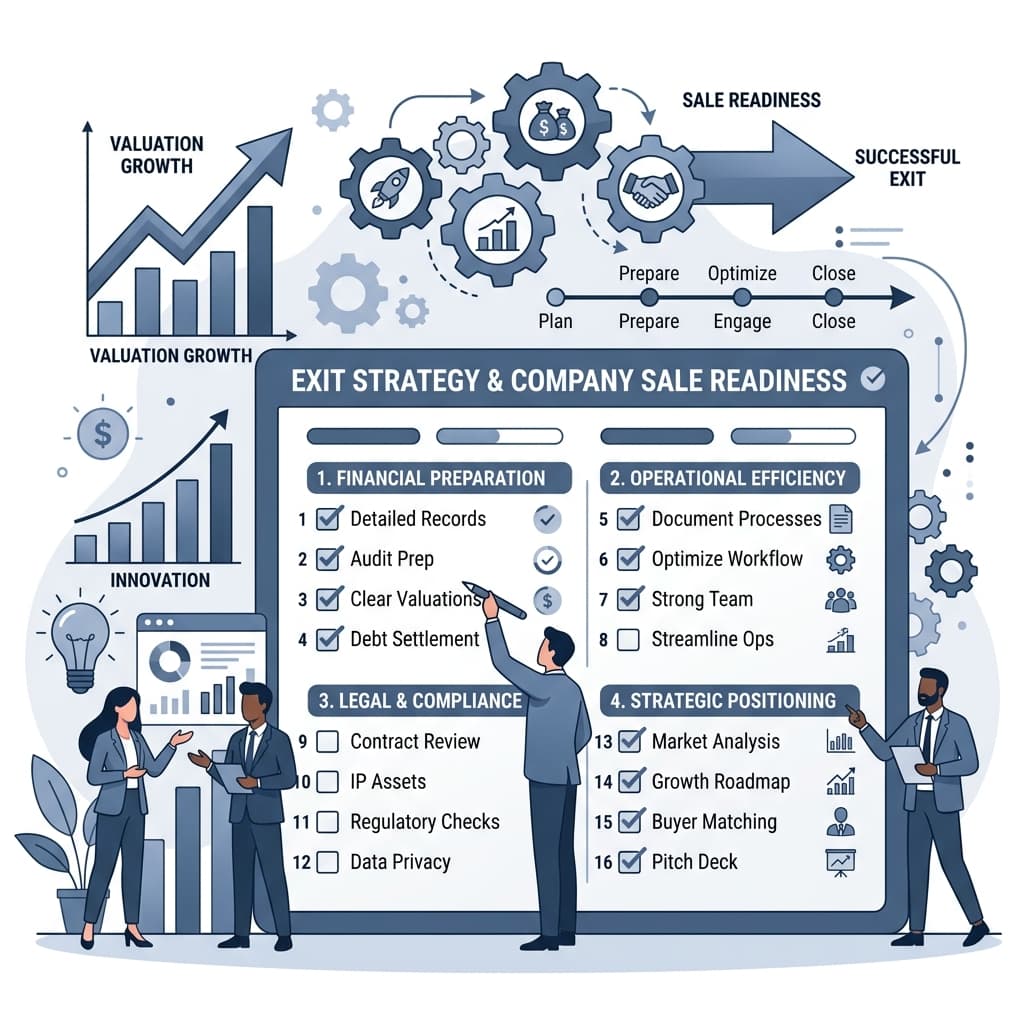
Every business owner I've talked to who sold their company says the same thing: they wish they'd started preparing earlier. Not because the process was hard, but because the things that matter most to buyers take time to build.
Getting a business ready for sale isn't a weekend project. Figure 12-24 months minimum from the day you decide to list.
Get Your Financial House in Order
Buyers start with the numbers. If your financials are messy, they either walk away or discount aggressively. Either way, you lose.
Clean up three years of financial statements
Most buyers want to see three years of profit and loss statements, balance sheets, and cash flow statements. These need to be consistent. If you changed accounting methods mid-stream or have gaps in your records, that's a red flag.
Run them through a CPA review. A "reviewed" financial statement carries more weight than an internally prepared one, and it's cheaper than a full audit.
Normalize your EBITDA
Your actual profit and your "adjusted" or "normalized" EBITDA are rarely the same thing. Buyers expect to see add-backs for:
- Owner's salary above market rate
- Discretionary expenses (personal vehicles, family travel, country club memberships)
- One-time legal or consulting fees
- Non-recurring expenses
Document every add-back with receipts or invoices. Buyers will verify these during due diligence. If you can't back up a claim, it doesn't count.
Separate personal and business finances
This sounds basic, yet it's one of the most common issues in small to mid-market deals. If your business pays for your car, your phone, your health insurance, and your family's travel, those need to be clearly documented as owner benefits, not buried in operating expenses.
A clean separation between personal and business finances signals that the business can run without you. That's exactly what buyers want to see.
Strengthen Your Revenue Profile
Buyers pay for predictable, recurring revenue. The more your business looks like a subscription model, the higher your valuation multiple.
Build recurring revenue streams
If you're a project-based business, explore retainer models. If you're a service business, consider maintenance contracts. If you sell products, look at subscription or consumable models.
Even 20-30% recurring revenue can lift your valuation multiple by 1-2x. For a business doing $2M in EBITDA, that's a $2-4M difference in sale price.
Reduce customer concentration
One customer representing more than 10-15% of your revenue is a risk. More than 25% is a dealbreaker for many buyers.
Start diversifying 18-24 months before sale. If you can't reduce the concentration, at least have long-term contracts in place with your largest customers. Multi-year agreements reduce buyer anxiety.
Show consistent growth
Buyers love a hockey stick curve. But they also respect steady, predictable growth. If you've grown 10-15% annually for three years, that's a more reliable signal than one year of 50% growth followed by a plateau.
Focus on demonstrating that your growth is repeatable. What's your customer acquisition channel? How much does it cost to acquire a customer? What's the lifetime value? If you can answer these questions with data, you're ahead of 80% of sellers.
Build Operations That Don't Need You
This is the hardest part for founders. You've built the business around your expertise, your relationships, your decisions. A buyer needs to see that the business can survive without you.
Document your key processes
Every critical business process should be documented. That includes sales, delivery, customer support, hiring, and financial management. The documentation doesn't need to be elaborate — a simple SOP with step-by-step instructions is fine.
What matters is that someone new could step in and follow the process without calling you every hour.
Build a management team
A business with a strong second tier of management is worth significantly more than one where the founder makes every decision. Identify 2-3 key managers who could run day-to-day operations. Give them real authority. Let them make decisions.
If you don't have internal candidates, consider hiring a COO or operations manager 12-18 months before the sale. The investment will pay off in valuation.
Implement systems, not heroics
Does your business depend on one person pulling all-nighters to close the month? Does customer service depend on your personal attention? Is there a single point of failure in your technology stack?
Fix these before you list. Buyers will find them during due diligence, and every one is a negotiation point against you.
Prepare Your Legal and Compliance Documentation
Smart buyers do thorough due diligence. Having your documentation ready before they ask signals that you're organized and transparent.
The data room checklist
A well-organized data room speeds up due diligence and builds buyer confidence. Include:
- Three years of financial statements (CPA-reviewed)
- Tax returns (three years)
- Customer contracts (top 20)
- Supplier agreements
- Employee agreements and handbooks
- Intellectual property registrations
- Insurance policies
- Material contracts and leases
- Corporate governance documents
Organize them in a virtual data room with clear folder structures. Responding to ad hoc document requests during negotiations is a signal of disorganization.
Address potential red flags early
Common issues that slow down or kill deals:
- Undocumented related-party transactions
- Pending or threatened litigation
- Regulatory compliance gaps
- Expired or missing intellectual property protections
- Employee classification issues (1099 vs W-2)
Fix these before potential buyers discover them. A known issue that you've addressed is much less concerning than an issue that surfaces during diligence.
Time Your Exit Strategically
Timing matters more than most sellers realize. Market conditions, industry cycles, and personal factors all affect your sale price.
Watch market conditions
M&A activity follows cycles. In a hot market (like 2021-2022), buyers paid premiums for growth. In a cooler market, they focus on profitability and cash flow.
Current conditions in 2026 favor businesses with strong recurring revenue, healthy margins, and diversified customer bases. If your business fits that profile, now is a good time.
Consider earn-out structures
If there's a gap between your valuation expectations and what buyers are willing to pay, an earn-out can bridge it. You get a lower upfront payment but earn additional compensation if the business hits certain performance targets post-sale.
Earn-outs are common in 30-40% of mid-market deals. They align incentives but require clear agreements about how performance is measured.
Work with the right advisors
A good M&A advisor pays for themselves. They help you prepare, identify the right buyers, manage the process, and negotiate terms. Look for someone who has sold businesses in your industry and size range.
Interview at least three advisors before choosing one. Ask about their deal pipeline, their success rate, and how they structure their fees.
Common Mistakes That Kill Deals
I've seen sellers make the same mistakes repeatedly. Here are the ones to avoid.
Waiting too long to start. If you think you're ready to sell in 6 months, assume it'll take 12. The preparation always takes longer than expected.
Overvaluing the business. Every owner thinks their business is special. Some are. Most aren't. Get a professional valuation early so you have realistic expectations.
Neglecting working capital requirements. Buyers calculate normalized working capital as part of the deal. If you've been running lean on inventory or receivables, the adjustment can be expensive.
Failing to plan for the transition period. Most deals include a transition period where the seller stays on. If you haven't thought about what happens after the sale, you're not ready.
What to do next
Selling a business is one of the biggest financial decisions you'll make. Preparation is the single biggest factor in whether you get paid what you deserve.
Start with an honest assessment of where your business stands today. Use aexit readiness assessment to identify gaps in your financials, operations, customer concentration, and documentation. Then work through the gaps systematically.
Your business took years to build. Take at least as long to prepare it for sale.
Ready to automate M&A drafting & secure transaction readiness?
AIVI empowers boutique M&A firms and investment banks to generate CIMs, conduct instant VDR gap checks, and manage exit readiness automatically from a unified data model.