AI VDR for Corporate Governance: Managing Board Records and Compliance Documents in M&A (2026)
AI VDR for Corporate Governance: Managing Board Records and Compliance Documents in M&A (2026) When a buyer's legal team begins their corporate governance review during confirmatory diligence, they are looking for something specific: evidence that the company has been run with institutional disc
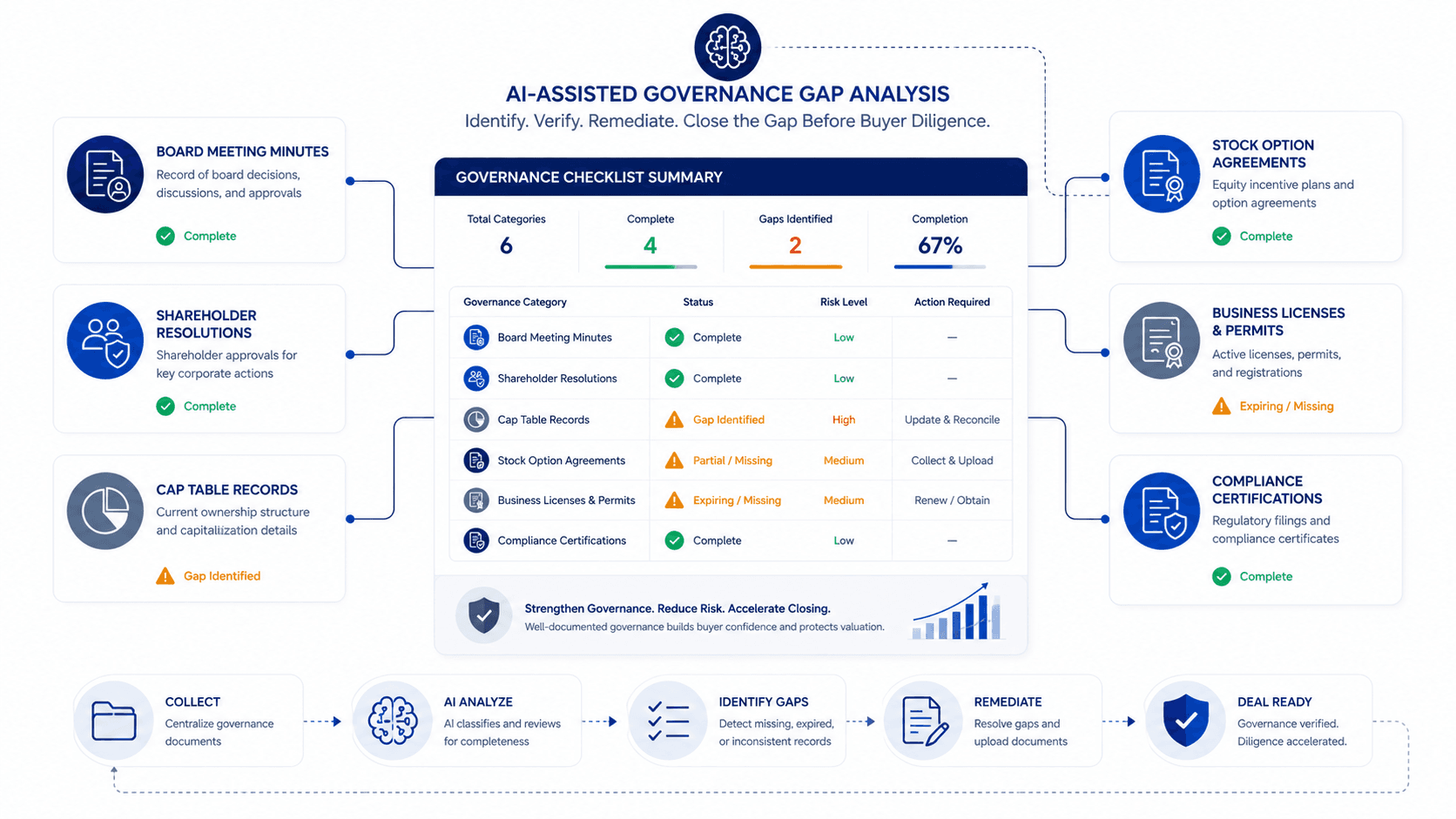
AI VDR for Corporate Governance: Managing Board Records and Compliance Documents in M&A (2026)
When a buyer's legal team begins their corporate governance review during confirmatory diligence, they are looking for something specific: evidence that the company has been run with institutional discipline over the period being acquired. That evidence lives in a specific set of documents — board meeting minutes, shareholder resolutions, equity records, officer appointments, and compliance certifications — that many owner-operated businesses have never maintained with the rigor that an M&A transaction requires.
This is not because the businesses are badly run. Most lower-middle-market companies with strong financial performance and loyal customer bases are operationally sound.
The governance documentation gap is a different issue entirely: it reflects the difference between how a privately held company actually functions on a day-to-day basis and how it needs to be documented for institutional buyers to complete their legal review with confidence.
The gap matters because governance documentation failures — missing board minutes, incomplete cap tables, unrecorded officer appointments, absent shareholder consents for major transactions — are among the most common triggers for legal escrow demands, extended closing timelines, and post-closing indemnification claims in lower-middle-market M&A. They are also almost entirely preventable when identified and addressed before the sale process begins.
Free Resource: Get a complimentary due diligence evaluation report to identify corporate governance documentation gaps that buyers are most likely to flag during legal diligence.
Why Corporate Governance Documentation Is the Most Commonly Neglected Diligence Category
Financial due diligence gets most of the attention in M&A transactions — and for good reason. The EBITDA figure drives the purchase price.
Financial discrepancies have direct, quantifiable valuation consequences. Sellers and advisors focus on financial records because the stakes are immediately obvious.
Corporate governance documentation is different. Its purpose is not to demonstrate performance — it is to demonstrate that the right people made the right decisions through the right processes over the period being acquired.
Its absence does not usually indicate that anything bad happened. It usually indicates that a privately held company operated the way privately held companies typically operate: decisions were made by the owner, communicated verbally or by email, and implemented without the formal recording infrastructure that institutional governance requires.
Buyers' legal teams, however, cannot rely on "nothing bad happened" as a representation. They need documentation.
And when documentation is missing, they have two choices: accept the risk and price it into the transaction structure through escrow or indemnification provisions, or require the seller to reconstruct or remediate the records before closing.
Neither option is efficient. Both cost the seller money.
In our experience across sell-side advisory engagements, the corporate governance category is where pre-launch preparation has the highest return on time invested. Governance gaps that take weeks to remediate under deal-timeline pressure can typically be addressed in days when identified six months before the process launches.
The Three Corporate Governance Areas That Most Frequently Cause Diligence Problems
Board and shareholder meeting records — Many owner-operated businesses have not maintained formal board meeting minutes, or have maintained them inconsistently. Years without formal minutes, or minutes that reference decisions that cannot be found in any other corporate record, are immediate legal diligence flags.
Equity and cap table accuracy — Cap tables that do not reflect actual ownership — because of informal equity transfers, unrecorded option grants, or paper shares that were issued but never formally cancelled — create closing-risk uncertainty that buyers address through escrow demands and additional representations.
Regulatory and compliance certifications — Businesses in regulated industries may have compliance certification gaps: expired professional licenses, unrenewed operating permits, regulatory filings that were late or incomplete. These items, when discovered during legal diligence, require regulatory engagement to resolve — which is almost never possible on the timeline buyers expect.
What We Actually See In Deals: The governance documentation gap that appears most frequently across lower-middle-market sell-side processes is board minutes that are missing for specific years — often the years when the most significant decisions were made. An owner who took on debt financing, changed the company's equity structure, or exited a line of business without a formal board resolution finds, during diligence, that the buyer's legal team needs documentation of a decision that was made over a phone call six years ago. Reconstructing that record after the fact, while buyers are waiting, is far more expensive than creating it properly at the time.
Case Studies: Governance Documentation in Two Transactions
Case Study: The Cap Table That Halted Closing
A technology services company in the Mid-Atlantic region was in final stages of closing an institutional acquisition when the buyer's legal team identified a discrepancy between the company's cap table and the articles of incorporation filed with the state.
The company had gone through an informal equity reallocation several years earlier: a founding shareholder had transferred a portion of their shares to a family trust, and another shareholder had been bought out partially in cash with the remainder converted to a promissory note. Neither transaction had been formally documented with a share transfer agreement, and the cap table spreadsheet the company maintained had been updated manually without a corresponding state filing.
When the buyer's counsel ran a UCC lien search and compared state corporate records to the cap table, the discrepancy was immediately apparent. Resolving it required locating both former shareholders, obtaining retroactive documentation of the transfers, and working with outside counsel to file corrected state records — all while the buyer's exclusivity period was running and their investment committee was waiting for a confirmatory close memo.
The transaction closed, but the closing date was pushed back by three weeks and the buyer required an additional escrow holdback specifically covering any claims that might arise from the equity transfer history. A cap table that had been properly maintained — or audited and corrected before the process launched — would have eliminated both costs entirely.
How It Should Be Done: Governance Remediation Before Process Launch
An industrial services company preparing for a PE-backed acquisition engaged their advisory team fourteen months before the target process launch date. One of the first activities was a complete corporate governance audit — a systematic review of every governance document category against what institutional buyers would expect to find in a well-maintained corporate record book.
The audit identified three years of missing board minutes during a period when the company had refinanced its senior debt facility and transitioned between accounting firms. It also identified two stock option grants to senior managers that had been communicated via email but never formally executed with option agreements.
Over the following four months, the company worked with outside counsel to reconstruct the missing board minutes — based on contemporaneous emails, loan documents, and accounting records from the relevant period — and execute proper option agreements with the managers. The reconstructed minutes were reviewed by counsel to ensure they accurately reflected the decisions that had actually been made.
When the PE buyer's legal team conducted their governance review, they found a complete and consistent corporate record. Their legal diligence memo addressed governance as a clean category.
The transaction closed without any governance-related escrow demands.
The Corporate Governance VDR Checklist: What Buyers Expect to Find
Category 1: Formation and Authority Documents
The foundational corporate governance layer covers the documents that establish the company's legal existence and the authority of its current officers and directors.
- Certificate or Articles of Incorporation/Formation: Original filing plus all amendments. Confirm the current document reflects the actual authorized share structure.
- Bylaws or Operating Agreement: Current version with all amendments.
Flag any provisions that require board or shareholder approval for a sale transaction. 3. State Good Standing Certificates: Current certificates from the state of formation and all states where the company is registered to do business. Most buyers require certificates dated within 90 days of closing. 4. Registered Agent Information: Current registered agent information in all states.
Category 2: Board and Shareholder Meeting Records
This is the category most frequently deficient in owner-operated businesses.
- Board Meeting Minutes (3-5 Years): Minutes for all regular and special board meetings. Each set of minutes should be signed by the meeting's secretary.
Minutes should reflect all material decisions: compensation changes, equity grants, debt transactions, material contract approvals, officer appointments and resignations. 2. Shareholder Meeting Minutes (3-5 Years): Minutes for annual and special shareholder meetings. Should include proxy records if any votes were conducted by written consent rather than in-person meeting. 3. Written Consent Resolutions: Any board or shareholder actions taken by written consent rather than formal meeting.
Should be executed by all required signatories with the date of consent clearly recorded. 4. Action Plans for Meetings with Missing Minutes: If minutes are missing for certain periods, the pre-launch remediation plan should include legal counsel reconstruction of those periods based on contemporaneous records.
⚠️ Common Mistake: Reconstructing missing board minutes after a buyer has already identified the gap. Pre-launch reconstruction, conducted with counsel before the diligence process begins, is far more defensible than reconstruction performed under buyer timeline pressure. The former is ordinary record maintenance; the latter can be characterized as after-the-fact document creation, which buyers treat very differently.
Category 3: Equity Records and Cap Table
- Cap Table: A complete, current ownership schedule showing all equity holders, share classes, ownership percentages, and any warrants, options, or convertible instruments. The cap table must be reconcilable to the articles of incorporation on authorized share count and to state records on issued shares.
- Stock Ledger or Membership Interest Register: The formal corporate record of all equity issuances, transfers, and cancellations, with dates and consideration for each transaction.
- Stock or Unit Certificates: Copies of all issued equity certificates, or confirmation that certificates have been cancelled and re-issued accurately.
- Option Plans and Agreements: All equity incentive plans, individual option grant agreements, and vesting schedules for all option holders.
Should be reconcilable to the cap table. 5. Shareholder Agreements: Any voting agreements, rights of first refusal, tag-along or drag-along rights, or anti-dilution provisions that affect the transaction structure.
Category 4: Regulatory Licenses and Compliance Records
- Business Licenses and Operating Permits: All material operating licenses and permits, including state professional licenses, local business permits, and industry-specific regulatory approvals. Confirm current status and expiration dates.
- Regulatory Filings: Material regulatory submissions from the past three years, including any correspondence with regulatory authorities.
- Compliance Certifications: Industry-specific compliance certifications (ISO, SOC 2, healthcare compliance, financial industry registrations) with current status confirmation.
- Litigation and Regulatory Action History: Any pending or threatened litigation, regulatory investigations, or enforcement actions, with resolution documentation for concluded matters.
Manual Governance Review vs AI-Assisted Governance Gap Analysis
Manual Corporate Governance Review
- Gap identification: Relies on advisor checklist and client memory; misses items not on the checklist
- Cap table verification: Manual reconciliation against state records; time-consuming for complex structures
- Minutes completeness check: Page-by-page review; inconsistent coverage across years
- License expiry tracking: Manual review of each license document for expiration dates
- Reconstruction coordination: Ad-hoc; varies by advisor and counsel relationship
- Pre-launch timing: Often begins too late; governance gaps discovered under buyer timeline pressure
AI-Assisted Governance Gap Analysis
- Gap identification: Systematic comparison of uploaded documents against complete governance framework
- Cap table verification: AI cross-references cap table fields against formation documents and equity records
- Minutes completeness check: Automated identification of date gaps in uploaded minutes series
- License expiry tracking: Automated flagging of licenses expiring within the transaction window
- Reconstruction coordination: Structured task assignment with timeline tracking
- Pre-launch timing: Governance audit completed before buyer access; gaps addressed in advance
How AIVI Supports Corporate Governance Preparation
The VDR remediation Kanban at AIVI incorporates corporate governance as a structured category within the pre-launch document preparation workflow. When a client completes the exit readiness diagnostic, governance documentation gaps — missing minutes series, cap table discrepancies, expiring licenses, absent equity agreements — are surfaced alongside financial and operational gaps in the same prioritized remediation task list.
Each governance gap becomes an assigned task with an owner, a deadline, and a status visible to both the advisor and the client. The task structure distinguishes between items that require client action (obtaining good standing certificates, executing option agreements), items that require legal counsel involvement (reconstructing missing minutes, correcting state filings), and items that require third-party engagement (renewing regulatory licenses).
This structured approach prevents the most common governance preparation failure: governance remediation being treated as a lower priority than financial preparation, with the result that governance gaps are discovered during buyer diligence rather than addressed in the pre-launch phase. The complete VDR due diligence checklist provides the full document framework that the governance category sits within, and the most common VDR mistakes guide covers how governance gaps translate into deal friction when they are discovered reactively rather than proactively.
Frequently Asked Questions
What corporate governance documents do buyers require in M&A due diligence?
Buyers' legal teams conduct a comprehensive corporate governance review that covers: formation documents (articles of incorporation or formation with all amendments), current bylaws or operating agreement, board and shareholder meeting minutes for the past three to five years, the cap table reconciled to state records, all equity certificates and option agreements, shareholder agreements, state good standing certificates, and regulatory licenses and compliance records. For companies in regulated industries, buyers also require evidence of current regulatory standing, any pending regulatory investigations, and material regulatory correspondence.
What happens if board meeting minutes are missing during due diligence?
Missing board meeting minutes during buyer diligence are a significant legal concern. Buyers' counsel cannot confirm that material decisions — equity issuances, debt transactions, officer appointments, material contract approvals — were properly authorized without the corresponding minutes.
This typically results in one of three outcomes: the buyer requests that missing minutes be reconstructed before closing (which takes time and creates questions about the reconstruction's accuracy), the buyer requires an escrow holdback covering potential claims from the missing period, or the buyer requires additional representations and warranties in the purchase agreement addressing the period of missing records. All three outcomes are more expensive for the seller than pre-launch governance remediation would have been.
How should a company handle informal equity transfers that were never properly documented?
Informal equity transfers — share transfers conducted verbally or by email without formal documentation — must be properly documented before a sale process launches. The remediation process involves working with outside counsel to reconstruct the original transfer terms based on contemporaneous evidence (emails, bank records, tax filings), preparing retroactive transfer documentation that reflects those terms, obtaining signatures from all relevant parties, updating the stock ledger and cap table, and in some cases filing corrections with the state of formation.
This process is achievable when initiated six or more months before the process launch, but becomes extremely difficult to execute during active buyer diligence on a compressed timeline.
Do PE firms care more about governance documentation than strategic buyers?
PE firms and strategic buyers both conduct legal governance reviews, but their concerns differ in emphasis. PE firms focus heavily on cap table accuracy and equity documentation because they are acquiring ownership and need to confirm exactly what they are buying.
Strategic acquirers focus more on regulatory compliance and license transferability because they are integrating the business into their existing operations. Both buyer types are concerned about missing board minutes, though strategic buyers may be slightly more willing to accept a representation and warranty approach to gaps while PE firms typically prefer pre-closing remediation.
How long does it take to remediate corporate governance documentation gaps?
Timeline depends heavily on the nature and extent of the gaps. Simple gaps — obtaining current good standing certificates, executing missing option agreements with employees who are still employed — can be remediated in days to weeks.
Complex gaps — reconstructing multiple years of missing board minutes, correcting cap table discrepancies that require coordinating with former shareholders, resolving regulatory compliance lapses — can take three to six months with active legal counsel involvement. This is why governance audits should be initiated at the same time as financial preparation — at least twelve months before the target process launch date for businesses with complex corporate histories.
Disclaimer: The financial and legal information provided in this article does not, and is not intended to, constitute professional legal or financial advice; instead, all information, content, and materials available on this site are for general informational purposes only. Readers should contact their legal counsel or certified public accountant to obtain advice with respect to any particular transaction or regulatory matter.
Ready to automate M&A drafting & secure transaction readiness?
AIVI empowers boutique M&A firms and investment banks to generate CIMs, conduct instant VDR gap checks, and manage exit readiness automatically from a unified data model.