AI VDR for Real Estate M&A: Accelerating Due Diligence in Property Transactions (2026)
AI VDR for Real Estate M&A: Accelerating Due Diligence in Property Transactions (2026) Commercial real estate transactions — particularly portfolio acquisitions, operating company sales, and real estate platform deals — have one of the most document-intensive due diligence profiles of any M&A ca
AI VDR for Real Estate M&A: Accelerating Due Diligence in Property Transactions (2026)
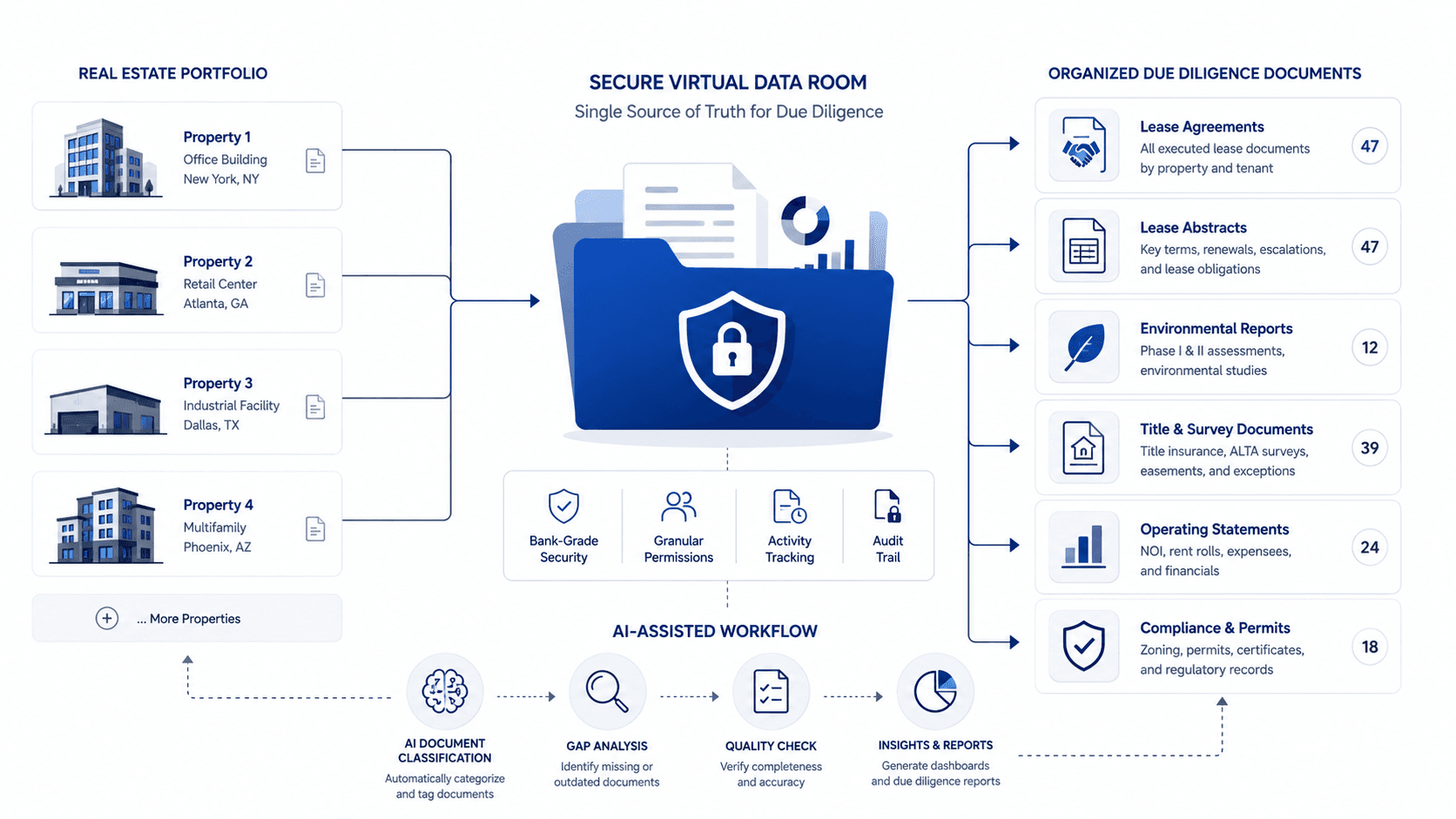
Commercial real estate transactions — particularly portfolio acquisitions, operating company sales, and real estate platform deals — have one of the most document-intensive due diligence profiles of any M&A category. A single commercial property acquisition can involve hundreds of documents: title records, environmental assessments, lease abstracts, operating statements, loan documents, zoning approvals, and insurance certificates.
A portfolio of ten or twenty properties multiplies that volume by an order of magnitude.
For decades, the standard approach to managing this document volume was a combination of physical site files, scattered email attachments, and the collective memory of the deal team about where critical documents were stored. This approach has never been efficient.
In 2026, as buyer sophistication and transaction velocity have both increased, it has become a meaningful competitive disadvantage for sellers and advisors who have not modernized their document management workflows.
AI-assisted virtual data rooms are changing how real estate M&A transactions are managed — not by replacing the analytical judgment of experienced real estate advisors, but by automating the document classification, risk scanning, and gap identification functions that consume disproportionate amounts of advisory time in complex property transactions.
Free Resource: Before opening your real estate transaction data room to any buyer group, run a complimentary due diligence evaluation report to identify document gaps and structural issues your advisory team can address before buyer access begins.
Why Real Estate M&A Due Diligence Is Uniquely Document-Intensive
Most M&A advisors who primarily work with operating companies are surprised by the document density of real estate M&A transactions. Several structural factors make real estate diligence categorically different from standard corporate M&A.
Property-level document silos: Unlike a corporate acquisition where all documents relate to a single operating entity, a real estate portfolio acquisition involves property-level documentation for each asset — separate title insurance policies, separate environmental reports, separate lease abstracts, separate operating statements — along with entity-level corporate documentation for the holding structure.
Third-party report dependencies: Real estate transactions require third-party reports — environmental phase I and phase II assessments, property condition reports, appraisals, ALTA surveys — that must be obtained, reviewed, and disclosed to buyers. These reports have specific content requirements, and outdated or incomplete reports are a common diligence delay.
Lease documentation complexity: For income-producing properties, each tenant relationship is governed by a lease agreement that must be reviewed for term, rent escalations, renewal options, assignment rights, co-tenancy provisions, and termination rights. A well-tenanted commercial property with a dozen leases represents a significant abstract and review workload even before other due diligence categories begin.
In our experience with real estate advisory engagements, the combination of these factors means that document organization failures that would cause moderate friction in a corporate M&A process can cause significant delays in a real estate transaction — where the document volume is higher and the third-party report timelines add scheduling complexity that does not exist in corporate deals.
What We Actually See In Deals: The most common source of delay in real estate portfolio transactions is not missing environmental reports or title issues — it is lease documentation that exists in property management systems, attorney files, and email archives rather than in a centralized, organized location. When a buyer's team requests a copy of all leases with renewal options expiring within 24 months, the sell-side team often has to spend days assembling documents that should have been in a single location all along.
Case Studies: Real Estate VDR Failures and Successes
Case Study: The Portfolio Transaction That Stalled Over Lease Abstracts
An advisory team managing the sale of a regional retail portfolio — a collection of strip mall properties across several Southeastern states — launched their marketing process with what they believed was a complete data room. The financial performance was strong, the anchor tenants were nationally recognized retailers, and buyer interest was significant from the outset.
The problem emerged during confirmatory diligence when the lead buyer's real estate counsel requested complete lease abstracts for all forty-seven leases in the portfolio. The advisory team had uploaded the original lease documents but had not prepared formal abstracts — structured summaries of the key economic and legal terms of each lease in a standardized format.
Producing forty-seven lease abstracts under buyer timeline pressure required engaging a real estate paralegal team that took three weeks to complete the work. During those three weeks, the buyer's deal team was in a holding pattern, their exclusivity period was running, and the buyer's investment committee had a scheduled presentation that was delayed because the diligence was incomplete.
The delay did not kill the transaction. But it created exactly the kind of deal friction that gives buyers leverage: the seller needed to close, the timeline was slipping, and the buyer used the situation to request a modest price reduction in exchange for their willingness to wait.
On a portfolio of meaningful size, that modest reduction translated to a real impact on seller proceeds.
How It Should Be Done: Pre-Packaged Property-Level Documentation
A contrasting situation involved the sale of an industrial real estate portfolio in the Mid-Atlantic region. The advisory team began VDR preparation six months before the target process launch date.
The preparation included not just uploading existing documents but producing a standardized property-level document package for each of the portfolio's properties.
Each property had its own folder in the VDR containing: the executed lease (or leases), a lease abstract prepared in the advisory team's standard format, the most recent environmental phase I report, the property condition report, the trailing 24-month operating statement, the current insurance certificate, and the title insurance policy.
When buyers entered the data room, they found the property-level documentation organized in exactly the format their own diligence teams would have organized it. The buy-side real estate counsel was able to begin lease review on day one without requesting additional documents for the initial review phase.
The financial diligence, lease review, and environmental review proceeded simultaneously rather than sequentially. The transaction closed within the projected timeline, and the seller's advisor described the process as one of the most operationally clean they had run in several years.
How AI VDR Tools Work in Real Estate Transactions
Phase 1: Property-Level Document Classification
AI-assisted VDR platforms applied to real estate transactions are configured to recognize real estate document types: lease agreements, title insurance commitments, environmental assessment reports, survey documents, property condition reports, operating statements, loan documents, zoning certificates, and insurance policies.
On upload, the classification engine identifies document type and assigns each document to the appropriate property-level subfolder. For large portfolio acquisitions, this eliminates the manual sorting process that typically falls to junior team members and takes days to complete accurately.
The AI also flags documents that appear to be missing from expected property-level packages — a property that has a lease but no environmental report, or a property that has a phase I but no survey — creating a gap list before any buyer has identified the same gaps independently.
Phase 2: Lease Abstract Generation and Review
Lease review is the most labor-intensive due diligence activity in income-producing property transactions. For each executed lease, a real estate attorney or paralegal must review the full document and prepare a structured abstract capturing: commencement and expiration dates, base rent and escalation schedule, renewal option terms, tenant improvement allowances, assignment and subletting rights, co-tenancy provisions, termination rights, and any pending disputes or default notices.
AI-assisted lease abstraction tools trained on commercial real estate lease language can generate preliminary abstracts from uploaded lease documents, identifying and extracting the key economic and legal terms in a standardized format. These preliminary abstracts require attorney review and approval before being used as the basis for deal decisions — the AI does not replace legal judgment, but it dramatically reduces the time attorneys spend on initial extraction work.
For a portfolio with twenty-five to fifty leases, AI-assisted abstraction can compress the lease review timeline from several weeks to several days, with attorney time focused on reviewing and validating AI-generated output rather than reading full lease documents for initial extraction.
Phase 3: Environmental and Compliance Document Tracking
Environmental diligence is a non-negotiable component of commercial real estate transactions. Buyers require phase I environmental assessments for all properties, and phase II assessments for any property where the phase I identifies recognized environmental conditions.
These reports have a shelf life — phase I reports are typically current for six months, and buyers may require updated reports if the existing ones are dated.
AI-assisted VDR tools can track the age of environmental reports in the data room and flag any reports that will expire before the projected closing date. This allows the advisory team to commission updates proactively rather than discovering during confirmatory diligence that the buyer requires a report update that will take four to six weeks to obtain.
Phase 4: Operating Statement Verification
For income-producing properties, the operating statements in the VDR are the financial foundation of the buyer's underwriting. AI-assisted document analysis can cross-check operating statement figures against rent roll data — identifying discrepancies between reported rental income and the rental rates in executed leases, flagging vacancy periods that are not reflected in the operating statements, and identifying expense categories that appear inconsistent with property type or size.
These cross-checks, when performed before buyer access begins, surface the kinds of operating statement issues that buyers' financial teams will identify during confirmatory diligence. Addressing them proactively — with explanations and supporting documentation already in the VDR — prevents the extended Q&A cycles that extend real estate diligence timelines.
Manual Real Estate VDR vs AI-Assisted Real Estate VDR
Manual Real Estate VDR
- Document organization: Property-level sorting done manually; inconsistent across assets
- Lease abstracts: Produced on buyer request; typically 2-4 weeks under deal pressure
- Environmental tracking: Manual monitoring of report dates; expiry often discovered late
- Operating statement review: Cross-checks against rent roll performed manually or not at all
- Gap identification: Reactive — gaps discovered when buyers request missing documents
- Portfolio transaction scalability: Linear increase in workload with portfolio size
- Typical diligence timeline: Extended by 2-6 weeks due to document production bottlenecks
AI-Assisted Real Estate VDR
- Document organization: Automated classification by document type and property
- Lease abstracts: AI-assisted preliminary abstracts generated on upload; attorney review focused on validation
- Environmental tracking: Automated expiry monitoring with proactive flagging
- Operating statement review: AI cross-checks against rent roll; discrepancies flagged pre-launch
- Gap identification: Proactive — complete gap list generated before buyer access begins
- Portfolio transaction scalability: AI classification scales with portfolio size without linear time increase
- Typical diligence timeline: Compressed by eliminating pre-launch document production bottlenecks
How AIVI Supports Real Estate M&A Advisory Workflows
While AIVI's platform is built around the exit readiness diagnostic framework used in corporate M&A advisory, the underlying workflow architecture — gap analysis, remediation task tracking, document preparation sequencing, and CIM alignment — applies directly to real estate transaction advisory as well.
Understanding what a virtual data room is and how its tiered access structure functions is the starting point for any real estate transaction VDR setup. The tiered access principles that apply to corporate M&A — early-stage buyers see financial summaries, LOI-stage buyers see detailed lease and title documentation — translate directly to real estate processes.
The VDR remediation Kanban workflow helps advisory teams track property-level document gaps across large portfolios: which properties are missing phase I reports, which leases need abstracts, which operating statements need reconciliation to the rent roll. The visual task board provides both advisor and client visibility into preparation progress against the timeline.
The automated deal document generation function, applied to real estate transactions, helps advisors structure the property-level financial narrative consistently across portfolio assets — ensuring that the revenue and expense characterization in the marketing package aligns with the operating statements that buyers will review in the data room.
Frequently Asked Questions
What documents are required in a real estate M&A data room?
A complete real estate M&A VDR includes property-level documentation (executed leases with abstracts, environmental phase I/II reports, property condition reports, ALTA surveys, title insurance policies, insurance certificates, and trailing operating statements) and entity-level documentation (corporate formation documents, ownership structure, mortgage and financing records, property management agreements, and compliance records). For portfolio transactions, each property should have a complete property-level document package in its own subfolder.
The total document count for a portfolio transaction scales with the number of properties.
How long does due diligence take for a real estate M&A transaction?
Real estate transaction due diligence timelines vary significantly with portfolio complexity. A single-property commercial acquisition can complete in four to six weeks of confirmatory diligence if documentation is well-organized.
A multi-property portfolio transaction with complex lease structures, environmental issues requiring phase II assessment, or title defects requiring resolution can run twelve to sixteen weeks. The most reliable predictor of timeline is how organized and complete the seller's documentation is at the start of the exclusivity period.
What is a lease abstract and why do buyers require it?
A lease abstract is a structured summary of the key economic and legal terms of a commercial lease agreement — commencement date, term, rent and escalation schedule, renewal options, tenant improvement allowances, assignment rights, co-tenancy provisions, and termination rights. Buyers require abstracts because reading full lease documents for every property in a portfolio is prohibitively time-consuming.
Well-prepared abstracts allow buyers to quickly assess portfolio lease quality, identify renewal risk concentrations, and focus full document review on leases with unusual or potentially problematic terms.
What environmental documents do real estate buyers require?
Standard commercial real estate transactions require a current phase I environmental site assessment for each property — a records-based review by an environmental professional that identifies recognized environmental conditions (RECs) that may indicate soil or groundwater contamination. Where the phase I identifies RECs, buyers typically require a phase II assessment — actual soil and groundwater sampling to characterize the contamination.
Phase I reports are typically current for six months under ASTM standard E1527-21; reports older than six months may require updating before the transaction can close.
How does AI assist with lease review in real estate transactions?
AI-assisted lease review tools extract key economic and legal terms from executed lease documents and populate standardized abstract templates. The AI identifies rent amounts, escalation schedules, expiration dates, renewal option terms, and assignment restriction language from the full lease text.
The AI-generated preliminary abstract is then reviewed and validated by a real estate attorney, who focuses their time on interpretation and legal judgment rather than initial extraction. For large portfolios, this workflow compresses lease abstract production from weeks to days without reducing the quality of legal review on the finalized abstract.
Disclaimer: The financial and legal information provided in this article does not, and is not intended to, constitute professional legal or financial advice; instead, all information, content, and materials available on this site are for general informational purposes only. Readers should contact their legal counsel or certified public accountant to obtain advice with respect to any particular transaction or regulatory matter.
Ready to automate M&A drafting & secure transaction readiness?
AIVI empowers boutique M&A firms and investment banks to generate CIMs, conduct instant VDR gap checks, and manage exit readiness automatically from a unified data model.