What Is an Exit Readiness Assessment and Why Every Business Owner Needs One
Most business owners think they're ready to sell. They're wrong. Here's what an exit readiness assessment actually checks and why it could mean the difference between $10M and $15M when you exit.
What Is an Exit Readiness Assessment and Why Every Business Owner Needs One
I've worked with dozens of business owners who thought they were ready to sell.
Almost none of them were.
You've spent years building your company. Maybe decades. You survived bad markets, beat competitors, built something with real value. But here's the question that matters: if a buyer showed up tomorrow with a fair offer, could you actually close the deal?
Most owners can't. Not because their business lacks value. Because they never prepared it for sale.
That's what an exit readiness assessment is for. It's the single most important step before going to market. And yet most owners skip it. I've seen the difference it makes firsthand. Let me show you.
What an Exit Readiness Assessment Actually Is
An exit readiness assessment is a structured evaluation of how ready your business is for a sale or ownership transition. I like to call it a pre-sale inspection — like getting a home inspection before listing your house, but for your business.
The assessment covers multiple dimensions: financial health, operations, legal standing, management depth, market position. The output? Brutally honest. Where you stand today. What's broken. What needs fixing. How long it'll take to get deal-ready.
Here's the key difference people miss. A business valuation tells you what your company is worth. An exit readiness assessment tells you whether you can actually sell — and how to maximize the price when you do. Those aren't even close to the same thing.
Why Most Businesses Aren't Ready (And Why It's Not Your Fault)
Here's a number that stops people cold: 70–80% of businesses that go to market never close.
Not because nobody wanted to buy. Because they weren't ready.
I've watched deal after deal fall apart over the same issues:
- Messy financials — personal expenses mixed with business accounts, incomplete records, inconsistent accounting
- Owner dependency — the business can't function without you making every call
- Customer concentration — one or two clients account for most of your revenue
- Tribal knowledge — everything lives in your head and nowhere else
- Legal loose ends — missing contracts, unresolved liabilities, unprotected IP
An exit readiness assessment catches all this early. When you can still do something about it.
Most owners don't know what they don't know. That's not their fault. It's just reality.
The 7 Things a Good Assessment Looks At
Here's what a proper assessment covers. In my experience, these seven areas determine whether a deal sails through or falls apart.
1. Financial Health
Buyers live and die by the numbers. If your books aren't clean, your deal is dead before it starts.
The assessment checks:
- Are your statements prepared under GAAP or similar standards?
- Are add-backs documented and defensible?
- Do you have 3–5 years of clean, auditable records?
- Are personal and business expenses separated?
- Is revenue recognition accurate?
Buyers will commission their own quality of earnings report during due diligence. An assessment helps you prepare for that scrutiny before it lands on someone else's desk. Trust me — you want to find your own problems before a buyer does.
2. Management Depth
Here's a hard truth I tell every owner I work with: a business that can't run without you isn't a business. It's a job.
The assessment asks:
- Is there a capable team in place?
- Can the business run 30–60 days without you?
- Are key employees under retention agreements?
- Are roles clearly defined and documented?
- Is there a succession plan for critical positions?
Businesses with strong management depth sell for 20–40% more. I'm not exaggerating. That's real data.
3. Customer and Revenue Concentration
Buyers crave predictable revenue. Heavy concentration scares them off. Period.
The assessment examines:
- What percentage of revenue comes from your top 1, 3, and 5 clients?
- Do you have long-term contracts with key customers?
- What's your churn rate?
- Is revenue recurring or project-based?
Rule of thumb I use: no single customer should be more than 10–15% of revenue. If you're at 40%+, you've got a deal risk. Full stop.
4. Operational Infrastructure
Buyers aren't buying your current revenue. They're buying a machine that keeps generating revenue without you.
The assessment reviews:
- Are key processes documented in SOPs?
- Do you have reliable tech systems and backups?
- Any single-source supplier risks?
- Facility and equipment in good shape?
- Insurance coverage adequate?
The more systematized your operations, the more attractive you are — especially to strategic acquirers. I've seen this play out more times than I can count.
5. Legal and Compliance Standing
Legal issues are deal killers. Don't let anyone tell you otherwise.
The assessment covers:
- Corporate registrations and licenses current?
- Signed contracts with customers, vendors, and employees?
- IP properly protected?
- Any pending or potential lawsuits?
- Regulatory compliance?
I've watched a single missing contract collapse an entire deal. Don't let that be you.
6. Market Position
Buyers need confidence your business can defend itself after the sale.
The assessment looks at:
- Market share and competitive positioning
- Defensible moat (brand, technology, relationships)
- Growth rate vs. industry benchmarks
- Key market trends
- Who your competitors are and what they do well
A clear competitive story makes it easy for buyers to justify your price to their investment committee. I've seen strong positioning add multiple points to valuation multiples.
7. Personal Readiness
This is the one most owners ignore. It's also often the most important.
The assessment evaluates:
- Are your personal financial goals aligned with a realistic sale timeline?
- Do you have a vision for life after the sale?
- Are you emotionally ready to let go?
- Do you have a trusted advisory team?
- Are estate and tax plans aligned?
The best-prepared sellers aren't just the ones with clean books. They're the ones who know what they want next. And they've got the right people to get them there.
The Exit Readiness Score
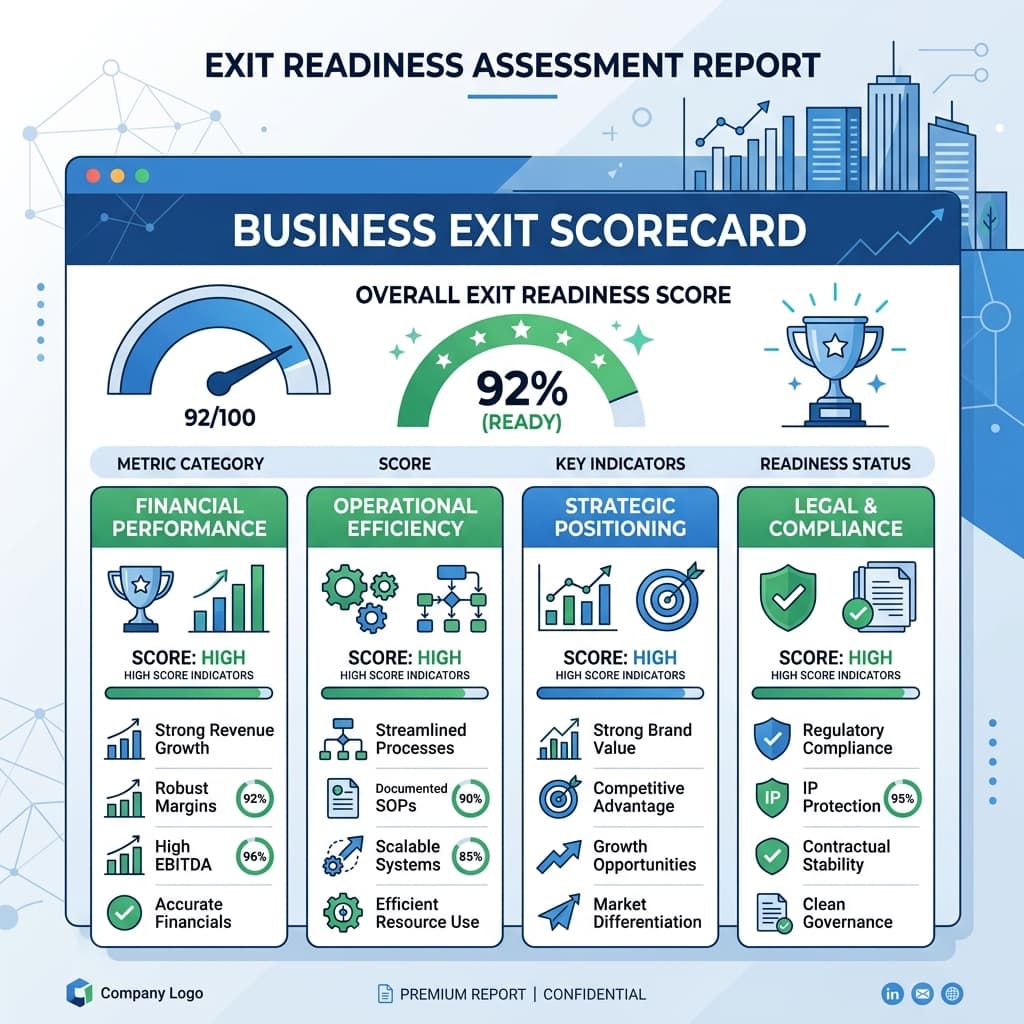
A good assessment produces a quantifiable score — usually 1–10 or a percentage. It gives you a baseline and a way to track progress.
Most businesses score between 3 and 5 on their first try. That's completely normal. Target 8 or above before going to market.
Every gap becomes an action item with a timeline and an owner. Some fixes take weeks. Others take months or years. But you'll never know which is which until you look.
When Should You Do This?
As early as possible. I'll be direct with you.
- 3+ years out: Major structural changes. Build a team. Diversify. Implement systems.
- 1–2 years out: Clean up financials. Resolve legal issues. Optimize operations.
- 6–12 months out: Prep marketing materials. Get preliminary valuations. Position your story.
- Already in a deal: Late, but not useless. You can still catch issues before they surface in due diligence.
The worst time to find a problem is when a buyer's inspector discovers it. An exit readiness assessment lets you fix things on your timeline. Not someone else's.
How This Differs From a Valuation
Simple breakdown:
A valuation tells you the price. An assessment tells you whether you can sell and what to fix.
The assessment comes first. Always. Don't pay for a valuation until your business can actually pass inspection.
A Real Example
Two businesses. Both earning $2 million in EBITDA.
Owner A skips the assessment. Goes to market with messy financials, no management team, 60% of revenue from one customer. Due diligence reveals everything. Deal gets re-traded at a 25% discount. Owner walks away with $10 million instead of $13 million. The process takes 14 months.
Owner B does the assessment 18 months before going to market. Cleans up financials. Signs a long-term contract with the biggest customer. Hires a COO. Goes to market clean and defensible. Multiple offers. Premium multiple. Total payout: $15 million. Process: 6 months.
The assessment cost Owner B somewhere between $5,000 and $15,000. The return? Over $2 million.
You do the math.
How to Get One
You've got a few options:
- Self-assessment — Use a checklist or online tool. Decent starting point, but you'll miss the objectivity.
- M&A advisor — Most reputable sell-side advisors offer an initial readiness evaluation. Expert guidance with real market context.
- Data-driven platform — Tools like AI Valuation Insight (aivaluationinsight.com) provide automated assessments scoring your business across all seven dimensions. Objective baseline, prioritized action plan, without the cost of a full advisory engagement.
Which one is right depends on where you are in your timeline and how much work your business needs. Be honest with yourself about that.
Bottom Line
An exit readiness assessment isn't a luxury. It's a necessity if you want to maximize your exit value and minimize deal risk.
It gives you clarity on where you stand. A roadmap for what to fix. A realistic timeline for getting deal-ready.
The businesses that sell at the highest multiples aren't the biggest or the fastest-growing. They're the most prepared. I've seen it happen over and over.
The gaps you identify today are opportunities to increase your eventual payout. Every single one.
If you want a clear picture of where your business stands, aivaluationinsight.com can get you started in minutes, not months. No advisory engagement required. Just straight answers about your exit readiness.
Ready to automate M&A drafting & secure transaction readiness?
AIVI empowers boutique M&A firms and investment banks to generate CIMs, conduct instant VDR gap checks, and manage exit readiness automatically from a unified data model.