"AI VDR Industry Analysis: How AI Is Reshaping the Market
AI VDR Industry Analysis: How AI Is Reshaping the Market
At an annual M&A advisory forum in New York during the summer of 2026, a managing partner at a boutique investment bank made a startling admission. His team had lost a lucrative sell-side mandate to a competitor that promised to complete due diligence preparation in half the time. The rival firm did not achieve this through extra staff, but by leveraging automated data rooms. In the modern transactions landscape, traditional document storage is no longer sufficient to secure business. Transaction advisors who rely on legacy document repositories struggle to justify their fees as client expectations shift toward speed and intelligence. Proactive dealmakers use smart systems to defend their market share.
Free Resource: Learn how to build clean, professional information packages using our CIM creation dashboard to attract buyers without manual writing friction.
Why Next-Gen Technology Has Reshaped the $2.2B VDR Market in 2026
The global virtual data room market in 2026 has reached a major structural transition point. Data tracked under corporate consolidation filings at FTC.gov reveals that mid-market deals require increasingly complex regulatory review. Traditional data rooms act as simple, static storage folders. They offer basic access permissions but require advisors to execute all document indexing, audit preparation, and risk scanning manually.
As regulatory filing standards governed by SEC.gov become more demanding, manual preparation has become a major deal bottleneck. Industry surveys of mid-market executives indicate that over 58% of deal delays are caused by disorganized document indexing. Next-generation platforms solve this challenge by integrating artificial intelligence directly into the file structures. These smart systems categorize files instantly, detect missing compliance papers, and identify signature gaps. This shift from simple storage to active transaction intelligence has redefined industry operational standards.
Case Studies: Two Advisory Firms, Two Outcomes
Our analysis of lower-middle-market advisors demonstrates the competitive advantage of adopting intelligent transaction platforms.
Case Study: The Traditional Advisor's Diligence Delay
A legacy advisory firm in the Midwest managed a $25M industrial service deal using a traditional document hosting provider. The team manually sorted through 400 financial and legal files, which took three weeks. During buyer diligence, several missing state tax clearances and unsigned board resolutions went unnoticed. The buyer's legal team discovered these gaps late in the process, resulting in a four-week closing delay and a $1.2M valuation adjustment.
How It Should Be Done: The Next-Gen Boutique Bank Success
Conversely, a boutique investment bank in the Southwest managed a similar $28M logistics transaction using an automated VDR. Before launching the deal, the system scanned the legal repository, identifying three client agreements that lacked updated change-of-control provisions. The advisory team resolved these gaps before sharing access with buyers. Due to the organized document layout, the buyer's team completed their audit in 10 days, closing the transaction at the full target multiple.
Roadmap for Implementing AI VDR Technology in Advisory Workflows
To transition from legacy repositories to smart transaction environments, advisors must implement a structured migration plan.
Phase 1: Automated File Ingestion & Indexing
- Migrate Historical Files: Upload unorganized corporate folders directly into the new platform without manual sorting.
- Execute Automated Categorization: Allow semantic classification models to tag files based on transaction taxonomies.
- Generate Searchable Indexes: Convert all scanned images into fully indexable documents using high-fidelity character recognition.
⚠️ Common Mistake: Organizing files manually before uploading, which defeats the efficiency benefits of automated system indexing.
Phase 2: Compliance Auditing & Risk Scoring
- Activate Risk Detection Scans: Configure the software to scan for critical transactional gaps like broad indemnity terms.
- Identify Document Anomalies: Highlight mismatched financial values between marketing materials and formal tax filings.
- Verify Signature Completeness: Scan corporate contracts to ensure all parties have executed necessary pages.
⚠️ Common Mistake: Reviewing flagged risk alerts without setting severity limits, causing teams to spend time on low-risk files.
Phase 3: Collaborative Remediation & Buyer Launch
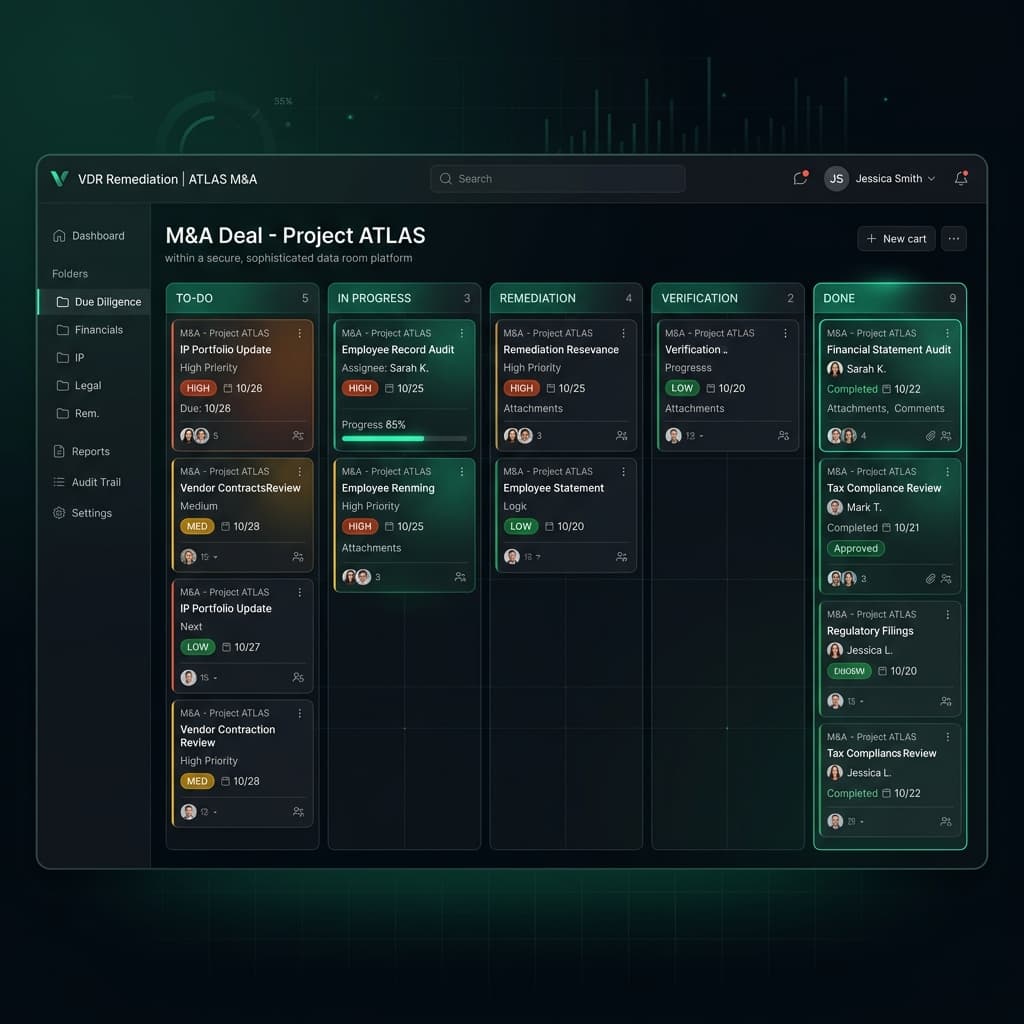
- Assign Kanban Remediation Tasks: Distribute flagged document gaps directly to the seller's legal representatives.
- Monitor Document Updates: Track corrections in real time to ensure the repository reaches full compliance before buyer launch.
- Configure Granular Access Controls: Set tiered buyer permissions, ensuring sensitive records remain hidden until final transaction phases.
⚠️ Common Mistake: Granting full repository access to buyers before completing the initial document compliance audit.
Traditional Repositories vs. Next-Gen AI VDR Platforms
Legacy Document Rooms
- Functionality: Basic secure file hosting with static storage folder structures.
- Indexing: Requires manual organization and tagging by junior transaction associates.
- Risk Identification: Dependent entirely on human reviewers scanning every page.
- Transaction Speed: Slow, average audit preparation times range from two to four weeks.
AI-Enabled VDR Platforms
- Functionality: Active document analysis including automated risk detection.
- Indexing: Near-instant automated categorization based on transaction type.
- Risk Identification: Semantic detection models flag contract gaps and anomalies.
- Transaction Speed: Fast, allows advisors to launch fully audited repositories in days.
How AIVI Powers Modern Advisory Practices
Investment banks utilizing AIVI's remediation Kanban system achieve faster transaction cycles and protect seller valuations. The platform analyzes your document repository, identifying missing tax filings, unredacted corporate names, and compliance gaps.
By turning legal gaps into structured remediation tasks, AIVI ensures your advisory team addresses transaction liabilities before buyer review begins. Furthermore, AIVI syncs with our CIM creation dashboard, ensuring that financial projections presented to potential buyers align with the data room files.
AI Powered M&A ToolStop Redrafting Deal Memorandums. Automate It.
Inconsistencies between your marketing deck (CIM) and the VDR files destroy transaction momentum. Let AI build your CIM directly from your verified ledger to guarantee 100% data consistency.
Frequently Asked Questions
What is next-gen AI VDR technology?
Next-gen AI VDR technology combines secure cloud hosting with machine learning to automate document classification, risk auditing, and compliance tracking during corporate deals.
How does AI categorization save transaction preparation time?
Semantic models recognize file types instantly, sorting hundreds of corporate documents into standard folders without junior associates doing manual tagging.
What are the main limitations of traditional virtual data rooms?
Traditional data rooms act as static storage boxes, offering security but lacking tools to spot missing signatures, term mismatches, or compliance red flags.
Can AI identify missing documents in a data room?
Yes. Modern platforms compare uploaded files against standard due diligence checklists, alerting advisors to missing records such as historic tax returns.
Is AI VDR technology compliant with global data privacy rules?
Yes. Secure platforms use private cloud infrastructures that comply with SOC 2, GDPR, and CCPA standards to protect confidential corporate information.
Disclaimer: The financial and legal information provided in this article does not, and is not intended to, constitute professional legal or financial advice; instead, all information, content, and materials available on this site are for general informational purposes only. Readers should contact their legal counsel or certified public accountant to obtain advice with respect to any particular transaction or regulatory matter.