"AI Document Risk Scoring in VDR: How to Automate M&A Due Diligence Red Flag Detection

AI Document Risk Scoring in VDR: How to Automate M&A Due Diligence Red Flag Detection
Imagine sitting at a negotiation table, only days away from closing a crucial sell-side transaction. Suddenly, the buyer's Quality of Earnings team flags a hidden change-of-control clause buried in an ancillary customer agreement. The deal stalls, the valuation drops, and trust evaporates. In modern M&A, minor omissions in disclosure documents trigger massive transaction setbacks. Traditional document review processes rely on tired associates scanning thousands of PDFs manually, leaving sellers exposed to human error. Today, modern dealmakers leverage automated algorithms to secure their folders. By implementing smart analysis, advisory teams scan, categorize, and address transactional gaps before buyers ever spot them.
Free Resource: Learn how to build a clean corporate repository using our interactive VDR preparation guide to pass buy-side due diligence.
Why VDR AI Risk Scoring Has Become Critical for M&A Advisors in 2026
The transaction environment of 2026 moves faster than ever. According to small business trends tracked by the SBA.gov, transaction cycles have compressed while compliance demands have doubled. A typical business in the $10M–$30M valuation range now requires disclosing over 250 distinct financial, legal, and operational documents. Regulatory disclosures, including standards mandated under SEC.gov filing rules, mean advisors must check corporate records for inconsistencies.
Failing to spot mismatched numbers between the marketing materials and the data room destroys seller credibility. Industry research indicates that nearly 43% of boutique M&A advisors struggle with document organization, often leading to transaction delays. Instead of hiring expensive external auditing networks to inspect every page, advisors use intelligent valuation platforms. Automated algorithms flag critical compliance omissions, helping transaction teams identify structural risks early. This proactive step ensures transaction pipelines remain clear of avoidable administrative bottlenecks.
Case Studies: How VDR Failures Cost Sellers Millions
In our experience across lower-middle-market sell-side engagements, document gaps remain the leading cause of transaction friction. The following cases illustrate the difference between manual checking and automated auditing.
Case Study: The Midwest Manufacturer Diligence Setback
During a sell-side engagement involving a Midwest industrial manufacturing business, the seller prepared their data room manually. The advisory team did not notice that two major supply contracts contained termination-for-convenience clauses. During confirmatory diligence, the buyer's legal team flagged these provisions as a severe concentration risk. Consequently, the buyer negotiated a $2.1M reduction in the enterprise purchase price, and the closing timeline was extended by 45 days.
How It Should Be Done: The Southeast SaaS Risk Remediation
Contrast this with a Southeast software provider preparing for a Series B recapitalization. The company utilized advanced technology to analyze their legal folders prior to launching the process. The automated review flagged four employment agreements missing intellectual property assignment documents. The advisory team resolved these gaps within 72 hours. By correcting the issues early, the seller maintained an 8.2x EBITDA valuation multiple, closing the round 20 days ahead of schedule.
The VDR AI Risk Scoring Checklist for Advisory Teams
To avoid transaction surprises, advisors must follow a structured approach to analyze their data rooms before buyer onboarding.
Phase 1: Ingestion and Optical Character Recognition (OCR)
- Consolidate Historical Files: Gather all legal entities, historic tax filings, and corporate governance papers into one staging folder.
- Execute High-Fidelity OCR: Process all scanned paper documents to ensure every paragraph is searchable, preventing scanned images from hiding key clauses.
- Verify Folder Metadata: Confirm that file names match their contents and contain no misleading tags.
⚠️ Common Mistake: Uploading non-searchable image-only PDFs that prevent AI algorithms and buyer teams from finding critical text.
Phase 2: AI Risk Metric Configuration
- Define Threshold Parameters: Set risk rules based on the target transaction type (e.g., asset sale vs. stock sale).
- Run Semantic Scanning: Scan for specific contract anomalies, including broad indemnification limits, uncapped liabilities, and restrictive covenants.
- Generate Deal Compliance Scores: Establish a baseline compliance index for the entire repository to measure preparation quality.
⚠️ Common Mistake: Treating all documents with equal severity, which leads to alert fatigue over low-risk documents.
Phase 3: Prioritized Remediation and Verification
- Export Task Lists: Convert flagged red flags into actionable steps for the corporate legal team.
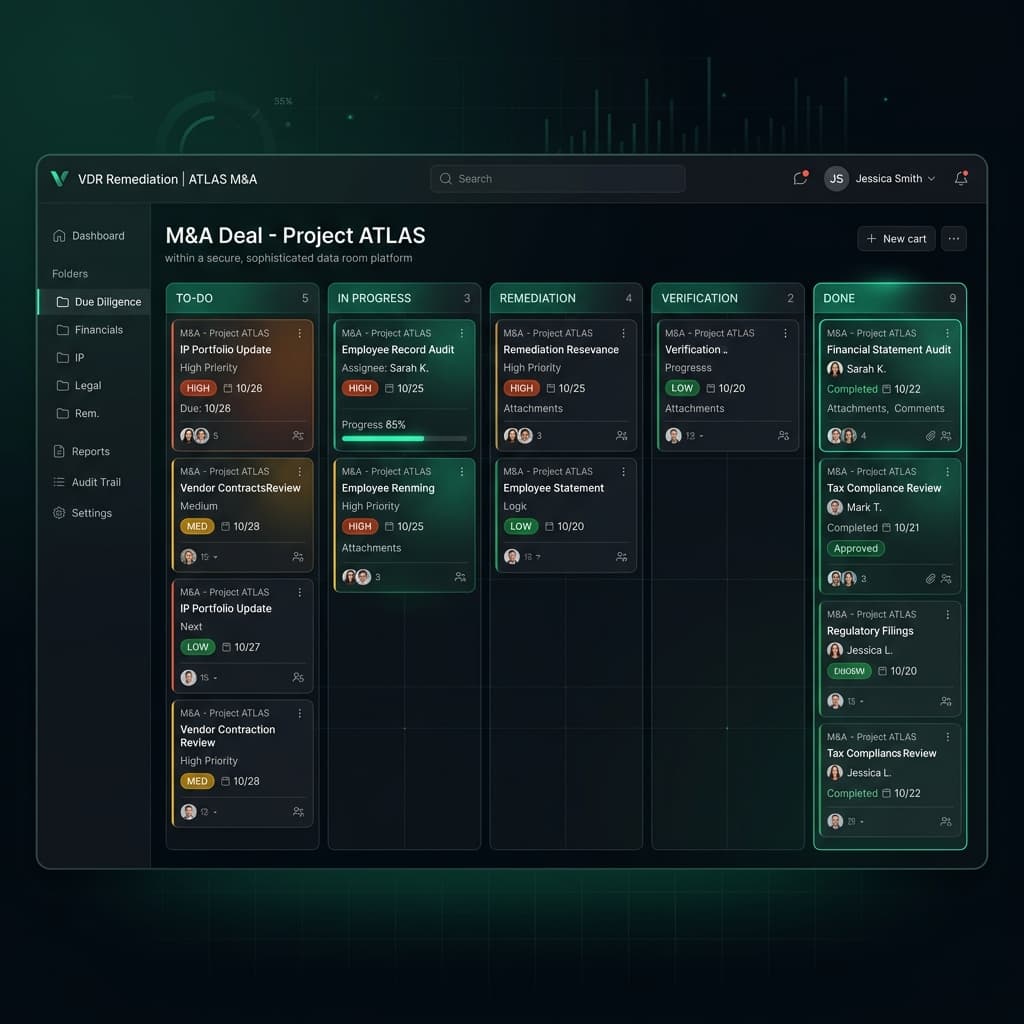
- Track Task Status: Monitor corrections in real time to ensure document replacements occur before buyer access is granted.
- Validate Final Updates: Re-audit the updated documents to confirm that the compliance score has improved.
⚠️ Common Mistake: Correcting documents without updating the version history in the main index, causing buyer confusion.
Traditional Document Auditing vs. VDR AI Risk Scoring
Manual Document Review
- Speed: Extremely slow, requiring weeks for associates to review hundreds of folders.
- Accuracy: Susceptible to human fatigue, frequently missing non-standard language in minor exhibits.
- Actionability: Results in disorganized Excel spreadsheets that require constant manual updating.
- Cost: Expensive, inflating advisory expenses through prolonged billable hours.
AI-Assisted Risk Scoring
- Speed: Near-instantaneous, processing thousands of pages within minutes.
- Accuracy: Highly consistent, scanning every file using advanced semantic algorithms.
- Actionability: Integrates directly with task tracking interfaces for structured corrections.
- Cost: Highly cost-effective, allowing advisors to focus on strategic negotiations.
How AIVI Streamlines Due Diligence for Boutique Advisors
Advisory teams using AIVI's AI-powered VDR remediation Kanban report significantly shorter transaction cycles. Rather than manually tracking compliance gaps, AIVI automatically audits your documents and generates structured Kanban tasks.
The system connects seamlessly with your files, identifying missing signatures, unredacted client names, and regulatory compliance issues. By addressing these items early, advisors maintain leverage throughout negotiations. Furthermore, the platform integrates with our automated CIM drafting tool, ensuring that financial metrics presented in marketing materials align perfectly with the data room contents.
AI Powered M&A ToolStop Redrafting Deal Memorandums. Automate It.
Inconsistencies between your marketing deck (CIM) and the VDR files destroy transaction momentum. Let AI build your CIM directly from your verified ledger to guarantee 100% data consistency.
Frequently Asked Questions
What is VDR AI risk scoring in M&A?
VDR AI risk scoring uses natural language processing to scan virtual data rooms, identifying missing documents, conflicting terms, and compliance risks to generate an audit preparation score.
How does AI detect due diligence red flags?
The software compares uploaded files against common transactional standards, flagging anomalies such as broad indemnity terms, missing signatures, or customer concentration clauses.
Can AI risk scoring replace legal counsel?
No. The technology serves as an initial diagnostic tool to identify formatting and organization issues, allowing legal teams to focus on solving high-level structural challenges.
Does AI document scanning expose sensitive corporate data?
Enterprise-grade platforms utilize secure, private LLM instances that prevent client data from being used in public training sets, ensuring strict confidentiality.
How long does a VDR AI audit take?
A complete automated audit of 300 documents typically completes in under 15 minutes, compared to several weeks for traditional human review.
Disclaimer: The financial and legal information provided in this article does not, and is not intended to, constitute professional legal or financial advice; instead, all information, content, and materials available on this site are for general informational purposes only. Readers should contact their legal counsel or certified public accountant to obtain advice with respect to any particular transaction or regulatory matter.