The Complete Guide to Business Valuation Methods for Small and Mid-Market Companies
A practical breakdown of the four core business valuation methods for small and mid-market companies: asset-based, market comps, income approach (DCF), and EBITDA multiples. Learn how each works and which one fits your situation.
The Complete Guide to Business Valuation Methods for Small and Mid-Market Companies
Every business owner I talk to has the same question at some point: "What's my business actually worth?"
It sounds simple, but it's one of the most loaded questions in M&A. The answer depends on who's asking, why they're asking, and — most importantly — which valuation method you use.
I've seen owners walk into meetings with a number in their head based on nothing more than a conversation with a friend or a quick Google search. And I've seen those same owners leave disappointed when the actual numbers tell a different story.
Here's the truth: there is no single "right" valuation for your business. There are multiple methods, each with its own logic, and the right one depends on your situation. What works for a tech startup with zero revenue but rapid growth won't work for a 30-year-old manufacturing company with steady cash flow and hard assets.
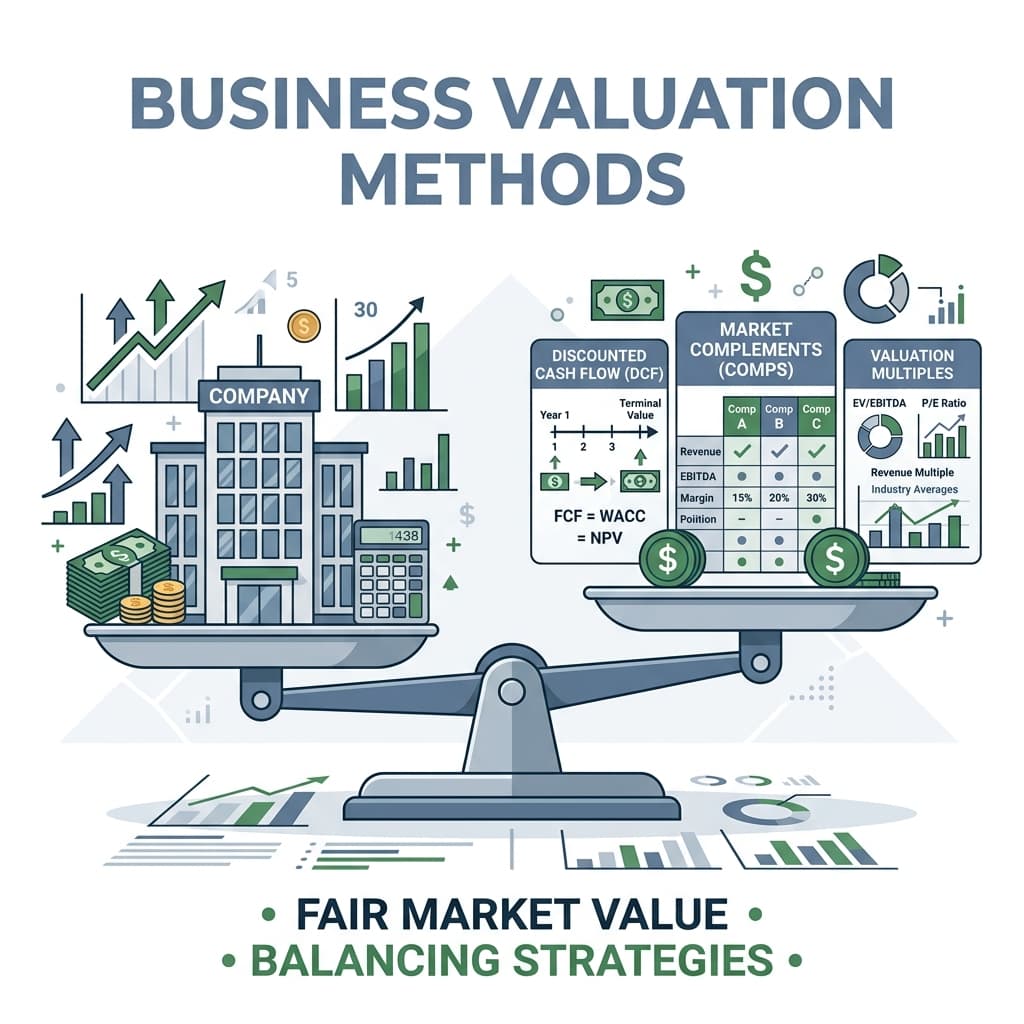
This guide walks you through the four main valuation methods used for small and mid-market companies — asset-based, market approach, income approach (DCF), and EBITDA multiples. By the end, you'll understand how each one works, when to use it, and why your valuation changes depending on the method you pick.
Why Valuation Method Matters
Before diving into the methods, let me be clear about something: valuation is not a science. It's a framework for negotiation.
Every valuation method makes assumptions. Change those assumptions, and the number changes. That's why you'll rarely get the same value from two different methods applied to the same business. Your CPA might value your company at $4 million using an asset-based approach, while a buyer suggests $6 million based on market comps. Neither is "wrong" — they're just looking at different data.
The smartest thing you can do as a business owner is understand all four methods well enough to know which one favors your position, and why.
Method 1: Asset-Based Approach
The asset-based approach is the simplest and most tangible valuation method. It answers the question: "What is this business worth if we sold everything and paid off all debts?"
How It Works
You start with your business's total assets — equipment, real estate, inventory, accounts receivable, cash, intellectual property, anything of value. Then you subtract total liabilities — loans, accounts payable, accrued expenses, any debt. The difference is your net asset value (NAV).
The formula looks like this:
Total Assets minus Total Liabilities equals Net Asset Value
That's the book value. Most buyers won't stop there, though. They'll adjust each asset to its fair market value — what it would actually sell for today, not what you paid for it five years ago. Equipment that cost $500,000 new might be worth $200,000 on the used market. Real estate you bought for $300,000 a decade ago might be worth $800,000 now. These adjustments can swing the valuation significantly.
When It Works Best
The asset-based approach is most useful for:
Businesses with significant hard assets. Think manufacturing, construction, transportation, or any company where the value is tied up in machinery, vehicles, real estate, or inventory.
Capital-intensive industries where replacement cost matters. If a buyer would need to spend $2 million to replicate your physical setup, that's a real floor for negotiations.
Distressed or liquidation scenarios. When a business isn't profitable but owns valuable assets, this method establishes a baseline.
When It Falls Short
The asset-based approach almost always undervalues service businesses, tech companies, and any business where the real value is in people, relationships, or intellectual property. A successful marketing agency might have $50,000 in office equipment and $2 million in annual profit. The asset-based approach says it's worth nearly nothing. That's clearly wrong.
It also ignores future earnings potential. Two businesses with identical asset bases could have wildly different futures — one growing at 20% per year, the other declining. The asset-based approach treats them the same.
For mid-market companies preparing for sale, the asset-based approach usually serves as a floor, not a target price. It tells you the minimum your business is worth, but you'll almost certainly sell for more if you have earnings and growth.
Method 2: Market Approach (Comparable Company Analysis)
The market approach is the one that sounds most like real estate: "What did similar businesses sell for?" It's the valuation method that's easiest for owners to understand and hardest to execute well.
How It Works
You find recent transactions of comparable businesses — same industry, similar size, similar geography — and look at the multiples those businesses sold for. Then you apply those multiples to your own financials.
In practice, you're looking at two types of data:
Public company comparables: If your business competes with publicly traded companies, you can look at their valuation multiples. The problem is that public companies are typically much larger, more diversified, and more liquid than private mid-market businesses. The multiples don't translate directly.
Private transaction databases: This is where M&A advisors earn their keep. Firms like IBISWorld, BizBuySell, Pratt's Stats, and Axial maintain databases of private company transactions. A good advisor can find 5-15 truly comparable sales and build a credible valuation range from those.
The Art of Finding Good Comps
Here's where most business owners get tripped up. A "comparable" isn't just another business in the same industry. A landscaping company with $1 million in revenue that operates out of a single truck is not comparable to a landscaping company with $5 million in revenue, a fleet of vehicles, commercial contracts, and a management team.
Good comps match on:
Industry and sub-industry. A residential home builder and a commercial contractor might both be "construction," but they sell at very different multiples.
Revenue and EBITDA ranges. Buyers pay higher multiples for larger businesses. A $2 million EBITDA business usually sells at a lower multiple than a $10 million EBITDA business.
Growth trajectory. A business growing 15% per year commands a higher multiple than one growing 3%.
Geography. Regional factors matter, especially for businesses with local customer bases.
When It Works Best
The market approach is strongest when there's an active M&A market in your industry and size range. For example, the market for HVAC companies between $2-10 million in revenue is active enough that you can find solid comps. The market for niche software companies serving a specific vertical is thinner — you might find only two or three relevant comps.
If you're in an industry with frequent, well-documented transactions, the market approach gives you the most defensible valuation. It's what buyers and sellers actually negotiate from.
Method 3: Income Approach (Discounted Cash Flow)
The income approach — specifically the discounted cash flow (DCF) method — is the most sophisticated of the four. It values a business based on its ability to generate future cash, adjusted for the time value of money and risk.
How It Works
You project the business's future cash flows — typically 3-5 years — and then discount them back to today's dollars using a rate that reflects the risk of those cash flows actually materializing.
The logic is straightforward: $1 million today is worth more than $1 million five years from now because you can invest today's money and earn a return. And $1 million from a stable, diversified business is worth more than $1 million from a volatile, customer-concentrated one because the risk is lower.
The discount rate is the key variable. For a stable mid-market company, the discount rate (often calculated as the weighted average cost of capital, or WACC) might be 12-18%. For a riskier business, it might be 25% or higher. Small changes in the discount rate produce big swings in valuation.
Real World: Why DCF Can Mislead You
In theory, DCF is the most "correct" valuation method. In practice, I find that owners and buyers rarely use it as the primary method for small and mid-market transactions. Here's why:
The projections are almost always optimistic. Every owner believes their business will grow faster and earn more in the future. Buyers know this. The negotiation becomes a debate about assumptions rather than a discussion about value.
The terminal value dominates. For most small businesses, the bulk of DCF value comes from the terminal value — the estimated value of all cash flows beyond your projection period. That terminal value is highly sensitive to the growth rate you assume. When two-thirds of your valuation comes from a guess about what happens in year 6 and beyond, the method loses credibility.
It's complex to explain to sellers. Most owners haven't encountered DCF before the M&A process. When they see a valuation built on discount rates and terminal values, it feels like a black box.
When DCF Actually Gets Used
DCF is most valuable in three scenarios:
High-growth companies where current earnings don't reflect future potential. A SaaS business that's unprofitable today but growing 60% per year needs DCF to capture its trajectory.
Capital-intensive businesses where you need to model large investments and their payback periods.
Buy-side analysis. Private equity firms and strategic acquirers often run DCF models internally to sanity-check their offer prices, even if they negotiate based on multiples.
Method 4: EBITDA Multiples (The Market Standard)
If you talk to ten M&A professionals about mid-market valuation, nine of them will start with EBITDA multiples. It's the workhorse method for businesses between $2 million and $100 million in enterprise value.
How It Works
You take your business's EBITDA — earnings before interest, taxes, depreciation, and amortization — and multiply it by a number that reflects your industry, size, growth, risk, and market conditions.
A few real-world multiple ranges as of 2025:
Business services: 4-7x EBITDA Manufacturing: 4-6x EBITDA Software / SaaS: 5-12x EBITDA Healthcare services: 5-9x EBITDA Construction: 3-5x EBITDA Distribution: 4-7x EBITDA
These ranges shift with market conditions. In a hot M&A market, multiples compress upward. In a downturn, they contract.
Why EBITDA Is the Metric That Matters
Buyers love EBITDA because it strips away variables that differ between businesses: tax strategies, capital structures, depreciation policies, financing costs. It gives you a clean view of operating performance.
For example, two identical businesses could have wildly different net incomes — one financed with debt (high interest expense), the other equity-funded (no interest). Their EBITDAs would be nearly identical, making comparison fair.
But here's the critical point: your seller's discretionary earnings (SDE) or EBITDA needs to be adjusted before applying any multiple. Owners routinely run personal expenses through their businesses — cars, meals, travel, family members on payroll. A buyer will "add back" these discretionary expenses to calculate true earning power. If you haven't done this adjustment yourself, you'll be surprised by the number a buyer calculates.
Factors That Move Your Multiple Up or Down
Every business has a base multiple determined by its industry. But specific factors can push that multiple higher or lower:
Concentration risk. If 60% of your revenue comes from one customer, expect a 1-2 turn discount on your multiple.
Owner dependence. A business that requires the owner to operate will trade at a lower multiple than one with a strong management team.
Growth rate. Consistent 10%+ annual growth adds 1-2 turns to your multiple. Declining revenue costs you at least that much.
Recurring revenue. Subscription or contract-based revenue commands a premium over project-based revenue.
Customer retention. High retention signals quality and predictability, both of which lift multiples.
Size matters. All else being equal, a $10 million EBITDA business will get a higher multiple than a $1 million EBITDA business. The buyer pool is larger, the risk is lower, and the transaction costs are a smaller percentage of deal value.
Which Valuation Method Should You Use?
The honest answer: all of them, but for different purposes.
Use the asset-based approach to establish your floor. Know what your business is worth in a worst-case scenario. This is your walk-away number in negotiations.
Use the market approach to understand what similar businesses have sold for. This is your best guide to what a buyer will actually pay. It anchors both sides of the negotiation table.
Use the income approach (DCF) to stress-test your growth story. If your business plan projects aggressive growth, run a DCF to see whether that growth justifies the premium you want.
Use EBITDA multiples as your primary framework for discussion. This is what buyers speak. Learn that language.
How Valuation Connects to Exit Readiness
Here's something most valuation guides won't tell you: your business is worth more when it's ready for sale. The same $2 million EBITDA company might be worth $8 million (4x multiple) when it's owner-dependent with messy books — and $14 million (7x multiple) after 18 months of preparation.
The difference isn't magic. It's cleaning up financials, reducing customer concentration, building a management team, and systematizing operations. Every point of multiple improvement adds real dollars to your payout.
Before you get a formal valuation, I recommend starting with an exit readiness assessment to identify the gaps that are costing you multiple points. A 2x improvement in your multiple on a $1 million EBITDA business is worth $2 million — well worth the effort.
Getting a Valuation That Holds Up in Negotiation
If you're serious about selling, don't rely on a single method or a single number. Build a valuation range using all four approaches, understand why they differ, and prepare to defend the method that best supports your position.
Your banker or M&A advisor should provide a valuation opinion as part of their engagement. If they can't articulate why they chose a 5x multiple over a 6x multiple, find someone who can.
And if you're still a few years out from a sale, use valuation as a diagnostic tool — not just a number. Run the EBITDA multiple calculation. See where you land. Then ask yourself: what would it take to move that multiple one point higher? Every action you take to strengthen your business also increases its value.
Final Thoughts
Valuation isn't a single event. It's an ongoing process that evolves with your business. The methods I've covered here — asset-based, market comps, DCF, and EBITDA multiples — are the foundation. Learn them, use them, and never walk into a negotiation armed with only one number.
The owners who get the best outcomes aren't the ones with the highest revenue or the fastest growth. They're the ones who understand how value is measured and have spent years building toward the metrics that matter most to buyers.
Want to know what your business is worth and what you can do to increase that number? [Check your exit readiness score] and get a personalized assessment that shows you exactly where you stand and what to fix first.
Ready to automate M&A drafting & secure transaction readiness?
AIVI empowers boutique M&A firms and investment banks to generate CIMs, conduct instant VDR gap checks, and manage exit readiness automatically from a unified data model.